From the way we communicate with one another to how we shop, bank and manage our daily lives, digitalisation continues to reshape the way we live. Payments are no exception.
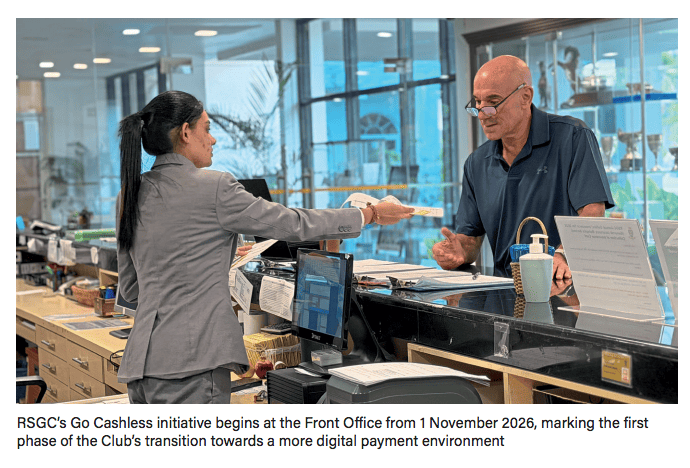
As part of RSGC’s continuing efforts to modernise its services and enhance the Member experience, the Club will commence the first phase of its Go Cashless initiative at the Front Office from 1 November 2026.
The move is about more than simply changing how Members make payments. It is part of a broader effort to make Club operations more efficient, strengthen financial controls, reduce the risks associated with cash handling and support more environmentally responsible practices.
MALAYSIA IS ALREADY GOING CASHLESS
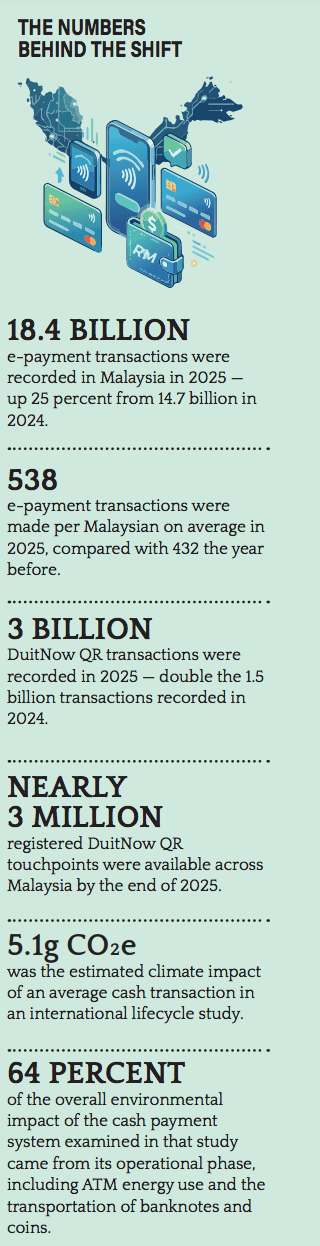
The way Malaysians pay has changed dramatically. According to Bank Negara Malaysia, 18.4 billion e-payment transactions were recorded nationwide in 2025, an increase of 25 percent from 14.7 billion transactions in 2024. That translates to an average of 538 e-payments for every Malaysian in 2025, compared with 432 the year before.
QR payments have experienced particularly strong growth. DuitNow QR transactions doubled from 1.5 billion transactions in 2024 to 3 billion in 2025, while the number of registered DuitNow QR touchpoints across Malaysia reached almost 3 million by the end of the year.
Malaysia has, in fact, consistently surpassed the Financial Sector Blueprint 2022–2026 target of at least 15 percent annual growth in average e-payment transactions per capita. Digital payment has therefore moved well beyond being simply an alternative to cash. It has become part of everyday life.
THE SUSTAINABILITY CONNECTION
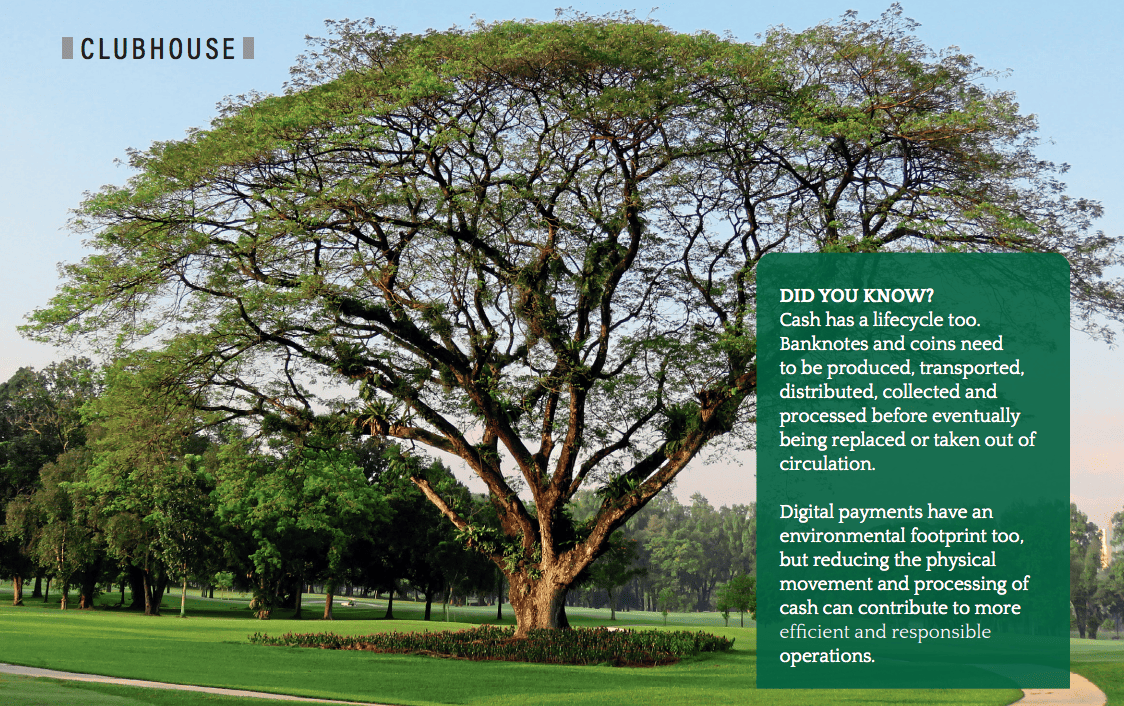
Going cashless can also contribute to more sustainable operations. Cash may appear simple at the point of payment, but maintaining a cash-based ecosystem involves considerably more behind the scenes. Banknotes and coins must be manufactured, transported, distributed, collected, counted, processed and, eventually, replaced or disposed of.
A peer-reviewed lifecycle assessment examining the environmental impact of cash payments in the Netherlands found that an average cash transaction generated approximately 5.1 grams of carbon dioxide equivalent (CO₂e).
Significantly, the research found that the operational phase, including the energy used by ATMs and the transportation of banknotes and coins, accounted for 64 percent of the overall environmental impact of the cash payment system.
Coin production accounted for a further 31 percent. This illustrates that the environmental footprint of cash extends well beyond the banknote or coin we see in our hands. There is an entire physical infrastructure required to keep money circulating.
Digital payments are not environmentally impact-free. They too depend on telecommunications networks, data centres, payment infrastructure and electronic devices. Nevertheless, reducing the physical movement and processing of cash can form one part of a broader approach towards more efficient and responsible operations.
SMALL CHANGES, COLLECTIVE IMPACT
For RSGC, the Go Cashless initiative is therefore not about one transaction or one payment counter. It is about progressively reducing unnecessary processes and finding smarter ways of operating the Club.
Less physical cash handling can mean fewer manual processes, improved transaction records, greater efficiency and reduced security risks. Over time, greater digitalisation can also help reduce reliance on paper-based processes and support more streamlined administration.
These may appear to be small operational changes individually, but sustainability is often achieved through the accumulation of many such improvements.
CONVENIENT, SAFE AND EFFICIENT
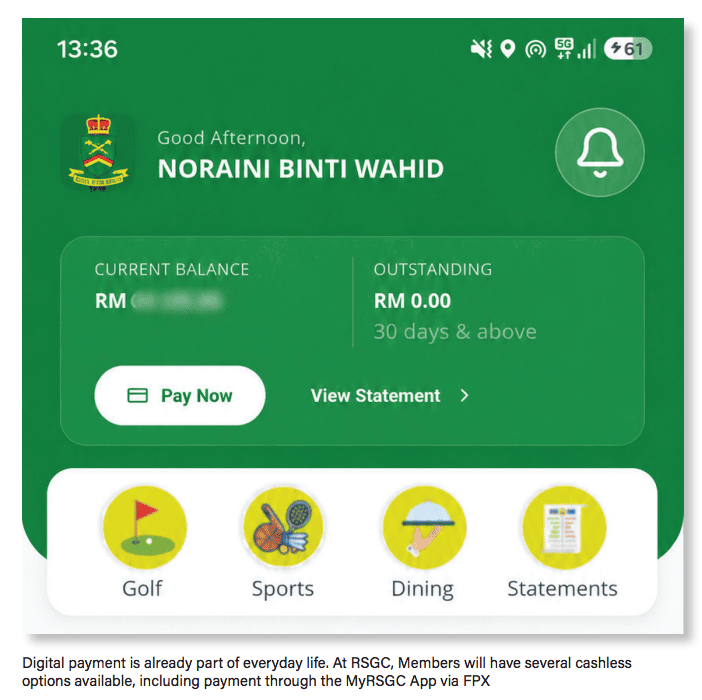
Members will have several cashless payment options available: • Credit / Debit Card • Direct Bank Transfer • Internet Banking / DuitNow QR • JomPAY • E-Wallet, where applicable • MyRSGC App via FPX.
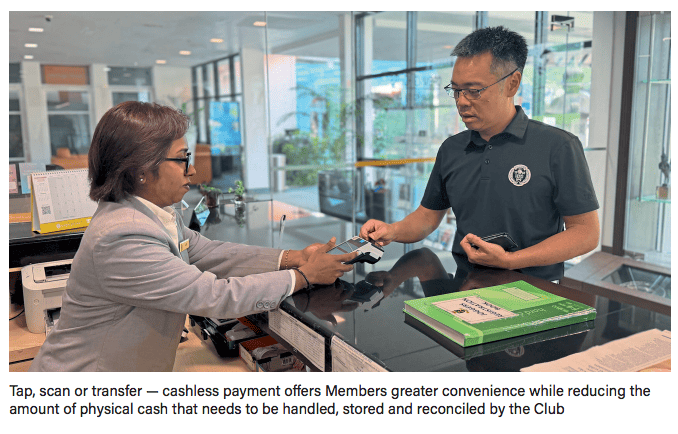
For Members, the benefits are straightforward: greater convenience, faster transactions and the ability to make payments securely without having to carry cash. Digital transactions also provide clearer payment records while reducing the amount of physical cash that needs to be handled, stored and reconciled by the Club.
A PROGRESSIVE TRANSITION
The Club recognises that changes in payment habits take time.
Therefore, when the first phase begins at the Front Office on 1 November 2026, cash payments will continue to be accepted during the transition period.
Members are nevertheless encouraged to use the available cashless payment methods whenever possible as RSGC progressively moves towards a more digital payment environment.
For online payments, Members are reminded to include their name and membership number in the payment details and forward proof of payment to admin@rsgc.com.my. The Go Cashless initiative represents another step in RSGC’s continuing journey towards a Club that combines tradition with modern convenience — improving the Member experience while embracing more efficient and responsible ways of operating.
NEED ASSISTANCE?
For enquiries about the Go Cashless initiative, available payment methods or assistance with making a payment, please contact the Club at: admin@rsgc.com.my
GO CASHLESS FROM 1 NOVEMBER 2026
Smarter payments. Greater convenience. A more sustainable RSGC.
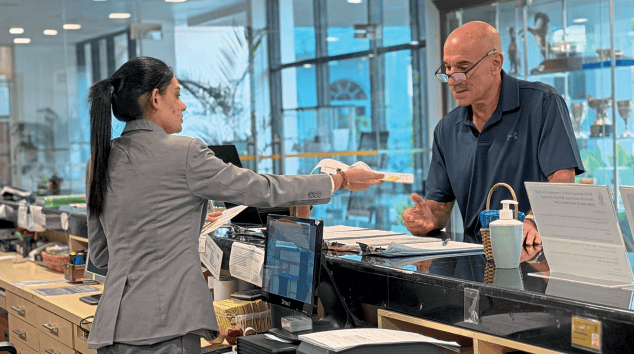
Card payments are among the cashless options available to Members as RSGC progressively moves towards a more digital payment environment
Sources: Bank Negara Malaysia, Annual Report 2025 – Promoting Safe and Efficient Payment and Remittance Services; Hanegraaf et al., Life Cycle Assessment of Cash Payments in the Netherlands, International Journal of Life Cycle Assessment.