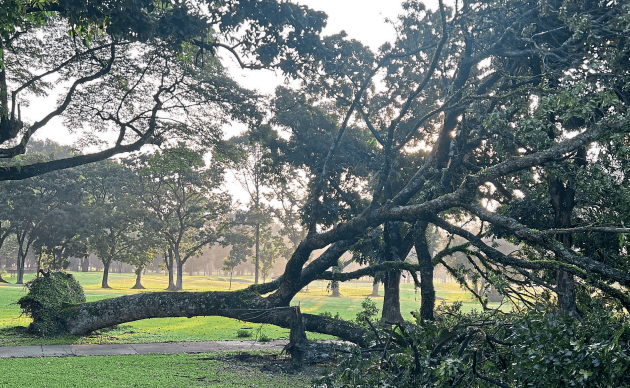
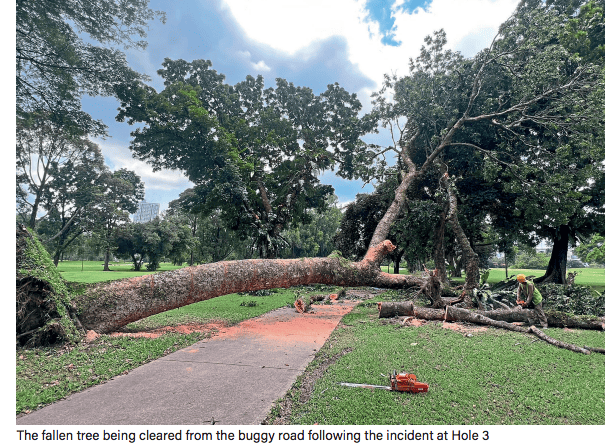
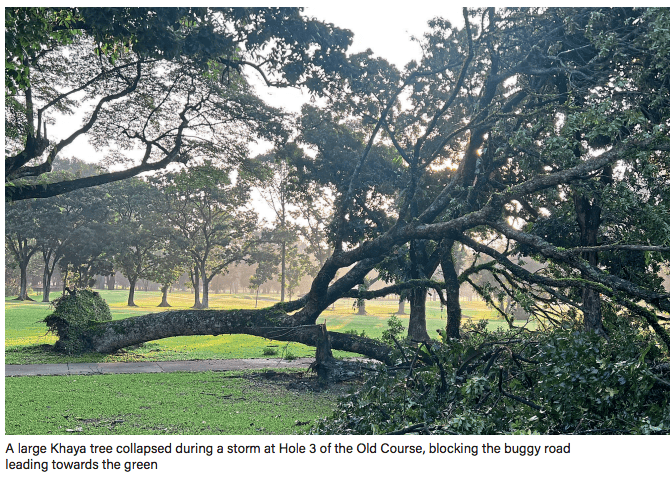
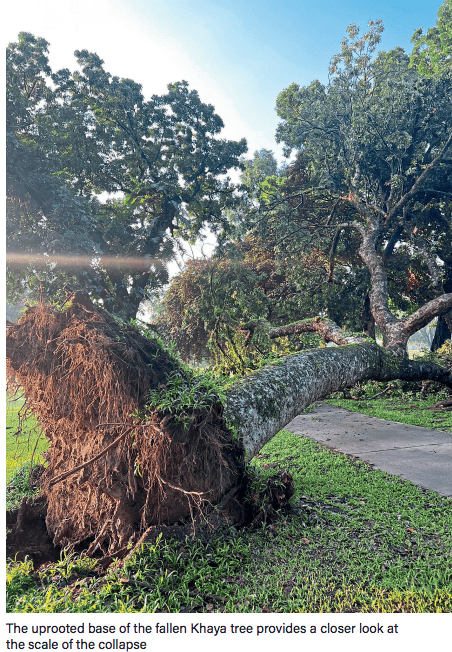
It had stood over the Old Course for years. Then, during a storm, a large Khaya tree at Hole 3 came crashing down, blocking the buggy road leading to the green and bringing a nearby mature mahogany tree down with it.
No landscape of RSGC’s age remains unchanged. Trees grow, mature and, over time, become increasingly important to the character of the golf courses. They provide shade, frame fairways and greens, support wildlife and form part of the landscape Members have known for generations. But mature trees also require careful management.
The incident at Hole 3 brings that responsibility into focus and raises a wider question: how do we preserve the value of mature trees while managing the risks that can develop as they age?
KNOWING THE KHAYA
Khaya, commonly known as African mahogany, is a familiar feature of tropical urban landscapes. Its broad canopy and substantial size make it an effective shade tree, but like other mature trees, its health and structural condition can change over time. Root health, disease, growing conditions, previous damage and exposure to severe weather can all influence the stability of an individual tree. That is why the condition of a mature tree cannot be determined simply by its size or appearance above ground.
Singapore’s National Parks Board (NParks), which manages an extensive urban tree population, has identified basal rot as one of the conditions that can affect Khaya trees. Decay around the base and root system can compromise structural stability, particularly when combined with adverse weather.
The experience elsewhere provides useful context, but it does not mean that every Khaya tree presents the same risk. Each tree must be assessed according to its own condition and surroundings.
MORE THAN JUST A TREE
Removing a mature tree is not a decision without consequence. A large, established tree represents years, sometimes decades of growth. Its canopy provides shade and cooling, contributes to the surrounding habitat and helps define the visual character of a landscape.
At a golf club, that relationship can be even more pronounced. Trees become part of the way a hole looks and plays. They frame sightlines, mark familiar points on the course and contribute to the character Members associate with particular areas of RSGC.
A replacement sapling may occupy the same ground, but it cannot immediately replace what has been lost. This is what makes mature tree management a balancing act: preservation where possible, intervention where necessary.
WEATHERING THE STORM
Severe weather adds another dimension. Heavy rainfall can saturate the ground, while strong winds place additional forces on trunks, branches and root systems. Trees already affected by disease, decay, restricted roots or structural weaknesses may consequently become more vulnerable during storms.
Changing weather patterns make continued observation and assessment increasingly important. Rather than treating every mature tree in the same way, good tree management considers species, age, health, location, surrounding activity and structural condition. A tree beside a frequently used buggy road, for example, presents a different risk profile from one standing well away from areas used by Members, staff or visitors.
CARING FOR RSGC’S LIVING LANDSCAPE
The collapse at Hole 3 is therefore more than an isolated image of a fallen tree. It is a reminder that RSGC’s landscape is living and constantly changing. The Club’s mature trees are among its most valuable natural assets, but preserving that landscape also requires regular observation, appropriate assessment and timely intervention when concerns arise.
Where a tree can safely be retained, its maturity and contribution to the landscape are worth preserving. Where intervention becomes necessary, the reasons should be understood and, where appropriate, future planting should consider the longterm suitability of species and location. Because replacing a mature tree is not simply a matter of planting another one. It takes years for a young tree to develop the canopy, character and environmental value of the tree it succeeds.
For a Club with more than a century of history, caring for the landscape means thinking not only about what Members see today, but what future generations of Members will inherit. The fall of one Khaya at Hole 3 may have happened in a matter of seconds. Growing the landscape that replaces it will take considerably longer.