Some walks take us somewhere new. Others remind us of what came before.” There are places that make you instinctively slow your pace. Tugu Negara is one of them. Standing majestically against the Kuala Lumpur skyline, the seven bronze figures of Malaysia’s National Monument command attention long before you begin to consider what they represent.
There is strength in their stance and triumph in their composition. Yet beneath it all lies something more solemn: remembrance. This is a monument created to honour those who gave their lives in the struggle for peace and freedom.
Standing before it amid the stillness of its landscaped grounds, it is difficult not to reflect on how easily we move through the Malaysia they helped shape — the city in which we work, the parks we enjoy and even the freedom to spend a morning simply walking through a forest. Before we trek, perhaps it is worth remembering them.
SEVEN FIGURES, A NATION REMEMBERS
The story of Tugu Negara takes us back to the early years of an independent Malaya. During an official visit to the United States in October 1960, Tunku Abdul Rahman Putra Al-Haj visited the famous Iwo Jima Memorial near Washington. Inspired by what he saw, the country’s first Prime Minister envisioned a monument in Kuala Lumpur to commemorate those who had died fighting the communist insurgency in Malaya.
The sculptor behind the Iwo Jima memorial, Felix de Weldon, was subsequently commissioned to create Malaysia’s National Monument. Tunku was personally involved in its development, even arranging for members of the military and police to be photographed as reference material for the eventual design.
Completed at Bukit Perwira near Parliament, Tugu Negara was officially inaugurated on 8 February 1966. More than six decades later, look up at those towering bronze figures and words such as courage, sacrifice and unity suddenly feel less abstract. History is not always something found in books. Sometimes, it stands before us in bronze. And just beyond this monumental expression of Malaysia’s history, Kuala Lumpur has preserved something altogether different. A forest.
FROM BRONZE TO GREEN
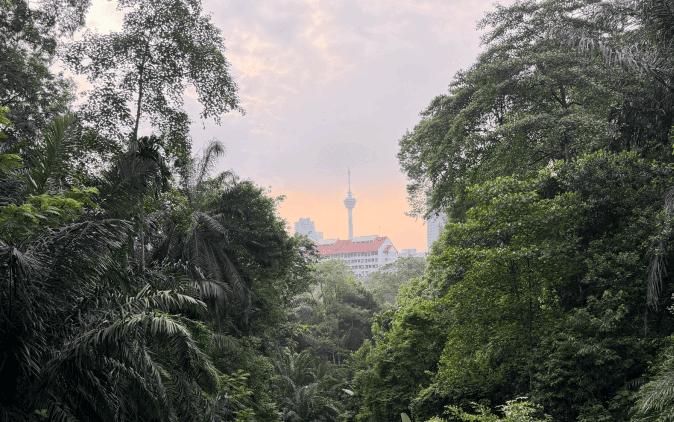
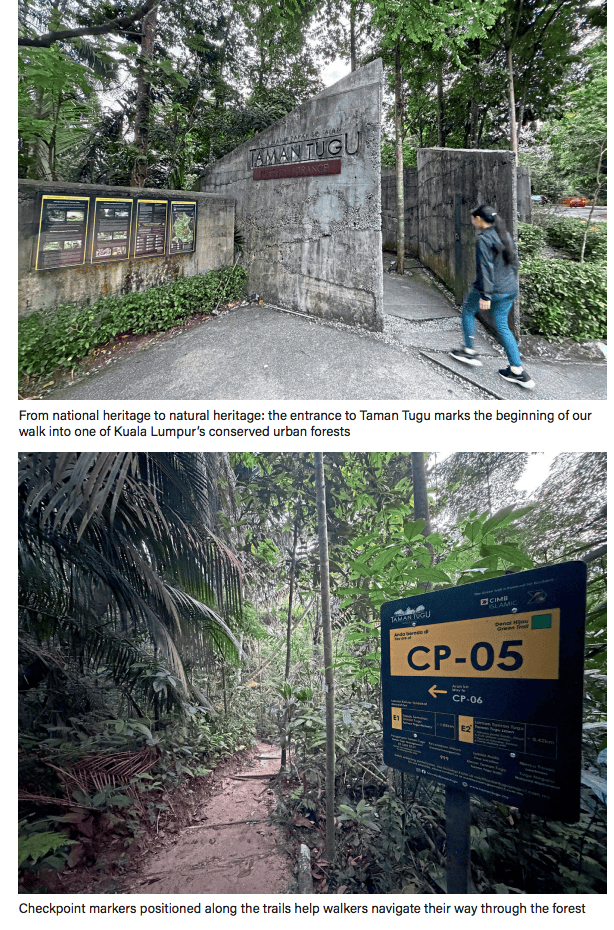
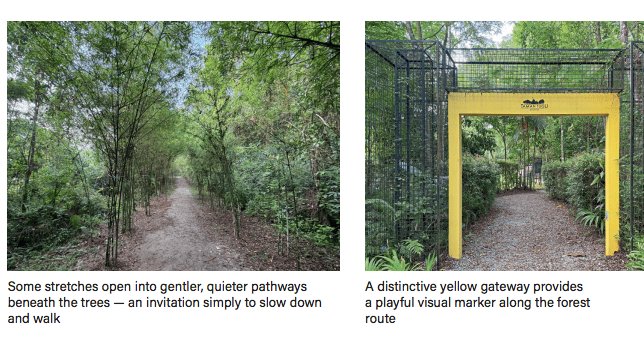
Leave the grandeur of Tugu Negara behind and make your way towards Taman Tugu, and the transition is remarkable. The monumental gives way to the natural. Bronze gives way to bark. Open sky gradually disappears beneath a canopy of green and, within a surprisingly short distance, the sounds of Kuala Lumpur begin to recede. Now, we walk.
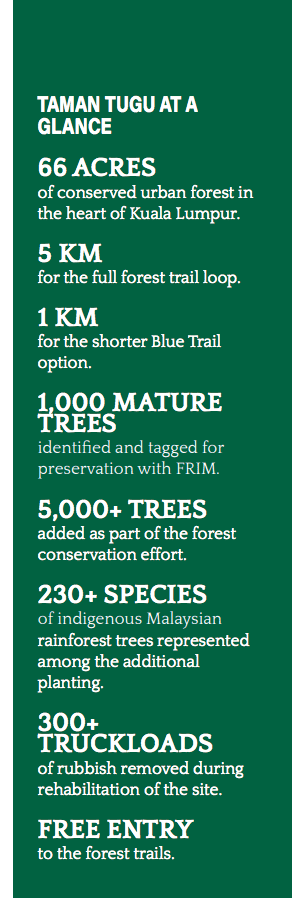
Taman Tugu occupies 66 acres of urban forest in the heart of the capital, yet once inside, it can feel remarkably removed from the city surrounding it. The full forest trail loop stretches approximately 5 kilometres, with a separate 1-kilometre Blue Trail available for those looking for a shorter outing.

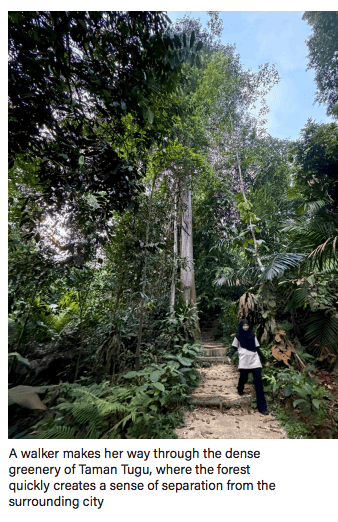
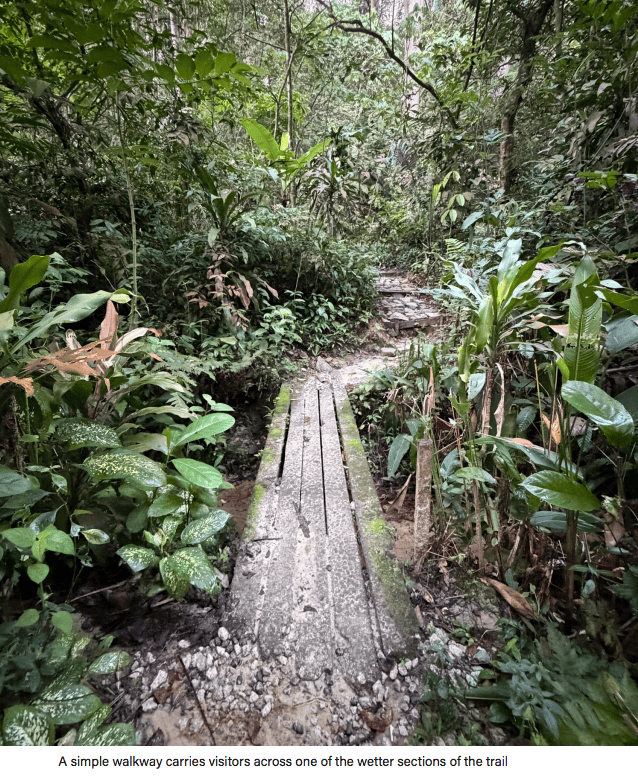
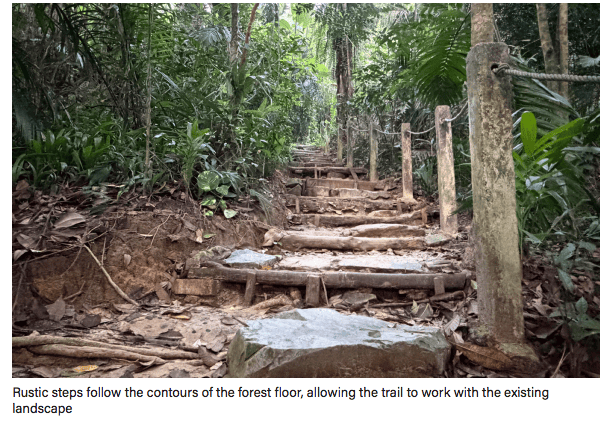
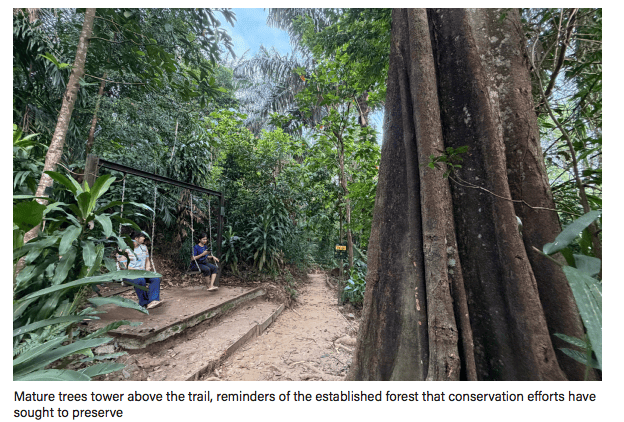
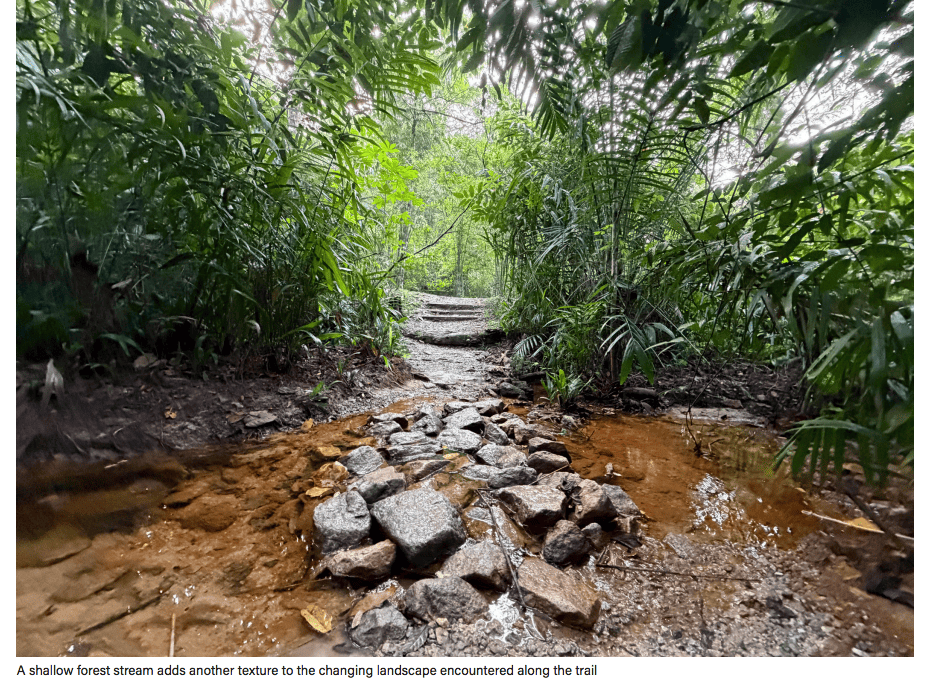
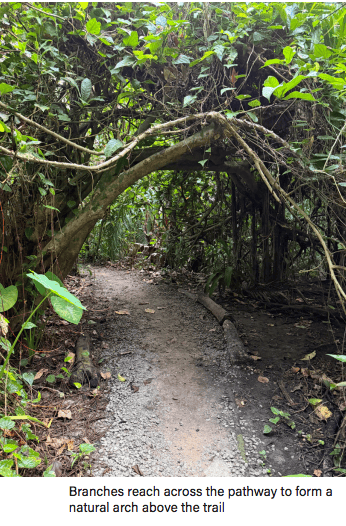
This is not a climb in the traditional sense. There is no summit waiting for us and no dramatic mountain panorama at the end. Instead, the pleasure is in the journey itself. The trail rises and dips through the forest. Roots cross the earth beneath your feet. Sunlight filters through the canopy. The path bends and disappears into another pocket of green.
It is approachable enough for beginners, yet substantial enough to feel like a proper walk. And if you begin paying attention to what surrounds the trail, another story emerges. Because this forest has a past.
HISTORY BENEATH OUR FEET
Among the vegetation at Taman Tugu are oil palms that may seem slightly out of place in a forest now being nurtured with indigenous rainforest species. Their presence tells part of the site’s story. Before independence, the area was home to British residences. Taman Tugu records that oil palms found along the trails are believed to be a legacy of that period, when the British brought oil palm seeds from West Africa and planted them for ornamental purposes.
After independence, the site became home to Malaysian government officials, including the country’s first Lord President, first Director of Agriculture and former Finance Minister Tun Tan Siew Sin. Eventually, government quarters occupied parts of the land. Look carefully as you walk today and traces of that earlier life remain. Concrete slabs — remnants of former quarters, can still be encountered along the trails. Suddenly, an ordinary forest walk becomes something else. You are walking across layers of Kuala Lumpur’s history.
THE FOREST THAT ALMOST WASN’T
Perhaps the most surprising part of Taman Tugu’s story is that the forest we enjoy today could easily have had a very different future. The 66-acre site was once proposed for a commercial tourist theme park, while other developers were also pursuing the land for development.
Instead, following engagement with communities and organisations including the Malaysian Nature Society, Khazanah Nasional moved towards conserving the secondary forest and transforming the site into a public green space.
Working with the Forest Research Institute Malaysia (FRIM), around 1,000 existing trees were identified and tagged for preservation. Among them are indigenous species including Jelutong, Tembusu, Pulai and Gaharu, with some potentially around a century old.
The conservation effort went further. More than 5,000 additional trees representing over 230 indigenous Malaysian rainforest species have been introduced. These include Keruing, Meranti and Mersawa, with around 1,000 of the added trees categorised as Endangered or Critically Endangered by the International Union for Conservation of Nature.
There was also another problem hidden beneath all that greenery. During development of the trails, parts of the site were found to have become an illegal dumping ground. More than 300 truckloads of construction debris, household rubbish and other discarded material were eventually removed.
What today appears to be an effortless pocket of green in Kuala Lumpur is therefore anything but accidental. It is the result of a deliberate decision to rescue, restore and protect.
NOT EVERY WALK NEEDS A SUMMIT
Perhaps that is why Taman Tugu works so well as an urban trek. There is no pressure to conquer anything. Complete the full 5-kilometre loop, choose the shorter trail, stop along the way, look at the trees, examine remnants of the site’s past or simply enjoy being somewhere green.
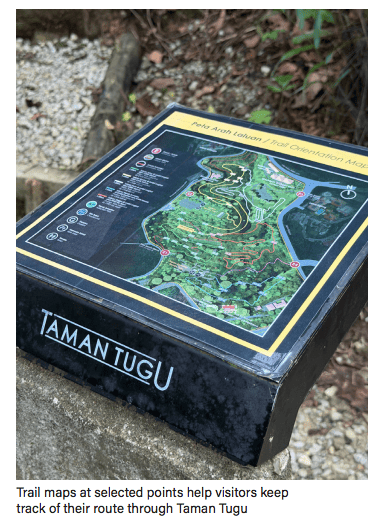
The trails are marked, with maps available at the trailhead and selected checkpoints. Taman Tugu recommends taking a photograph of the trail map before setting off for reference along the way. The terrain is approachable, but this remains a forest trail rather than a paved city promenade. Comfortable sportswear and proper sports or walking shoes are recommended, along with drinking water and insect repellent.
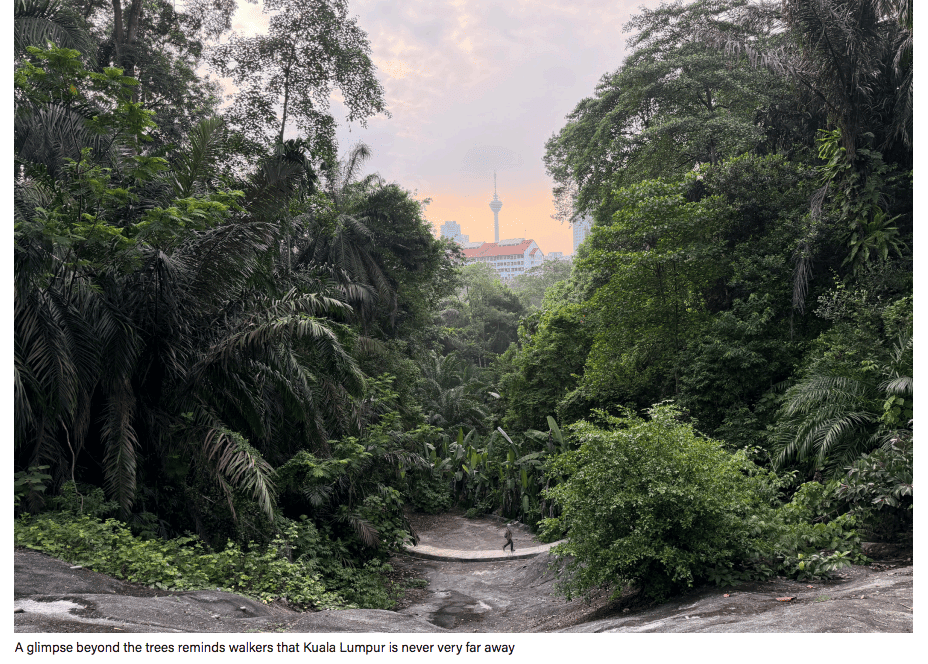
And perhaps the best thing about it? You haven’t had to drive an hour out of Kuala Lumpur to find it. Sometimes adventure is not about how far we travel. It is about noticing what has been sitting quietly beside us all along.
BEFORE YOU GO
Taman Tugu is open daily, including weekends and public holidays, from 7.00 am to 6.30 pm, with last entry to the forest trails at 5.45 pm. Entry is free. The main Taman Tugu Nursery parking area is open daily, while additional parking options operate on weekends. Wear comfortable sports attire and suitable walking shoes, and bring drinking water and insect repellent, particularly if you plan to complete the longer trail.
Visitors should remember that this is a conservation area. Pets and bicycles are not permitted on the forest trails, and wildlife should neither be fed nor disturbed. The park may close during inclement weather or when there are health or safety concerns, so check conditions before setting out.
ONE WALK, TWO KINDS OF HERITAGE
Eventually, the trail brings us back towards the city. Traffic returns. Buildings reappear. Kuala Lumpur reminds us that it was never really very far away. But perhaps we leave seeing this familiar corner of the capital a little differently.
We began our walk beneath towering bronze figures that remind us of lives given in the service of a country. We continued beneath a living canopy that another generation has chosen to preserve. One protects memory. The other protects nature. And both, in their different ways, ask something similar of us:
To remember what came before.
To value what has been entrusted to our generation.
And to leave something worth inheriting by the next.
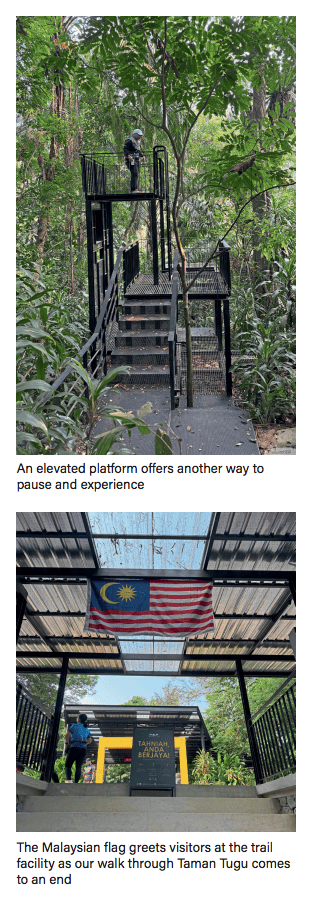
Perhaps this month’s trek was never really about completing five kilometres. It was about taking a walk through Kuala Lumpur and discovering that between a monument and a forest lies a story about remembrance, preservation and what we choose to carry forward. Sometimes, the best way to rediscover our city is simply to walk through it.