Technology was supposed to make life easier. And, to be fair, it has. We can order dinner without speaking to anyone, pay a bill without visiting a counter, summon a car to our doorstep, check into a flight from the sofa and transfer money before the person sitting across the table has finished saying, “I’ll send you my account number.”
Wonderful. Except somewhere along the way, convenience became rather complicated. Consider the humble cup of coffee. Once upon a time, you walked into a café, ordered one and paid. Now? “Do you have our app?” No. “You should download it. You can collect points.”
Fine. Download. Create account. Enter email address. Verify email address. Create password.
Password must contain at least eight characters, one uppercase letter, one lowercase letter, one number, one special character and, presumably, the name of your firstborn child.
Finally. Coffee. And that is just one app.
Our phones are now filled with little squares promising to simplify our lives. There is an app for banking. Another for parking. Several for shopping. One for food delivery. Another for transport. One for the airline. One for the hotel. One for the building. One for groceries. Even things that already have perfectly functional websites would really, really like us to download their app.
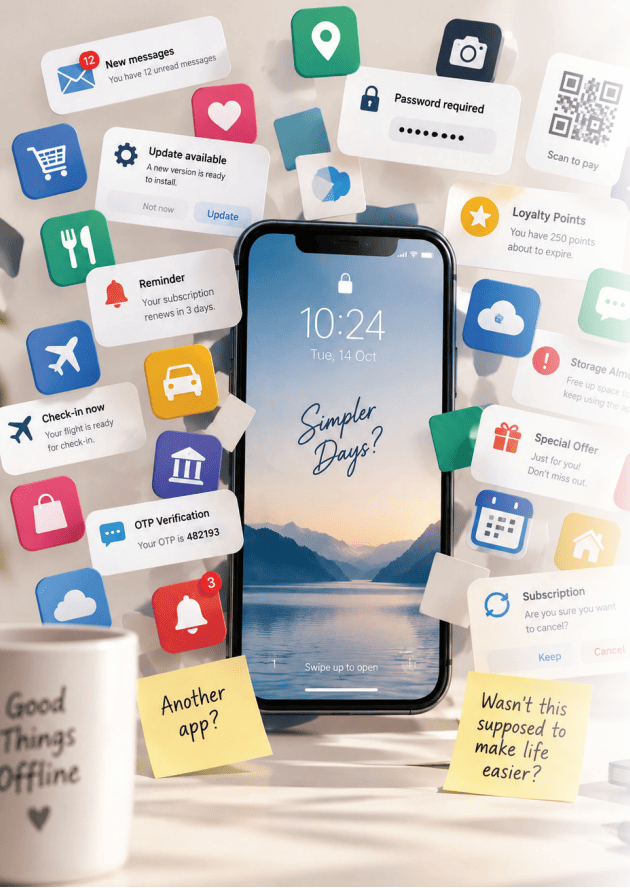
Then come the passwords. The OTPs. The updates. The notifications. The subscriptions we forgot we had. The loyalty points about to expire. The QR code that refuses to scan precisely when six people are waiting behind us. And the app that suddenly logs us out after six months of recognising our face perfectly well. “Forgot password?”
Apparently, yes.
THE PRICE OF SAVING TIME
None of this means technology has failed us. Quite the opposite. Tasks that once required a journey, a queue, a form and perhaps half a day can now be completed in minutes. We carry a bank, camera, map, newspaper, television, shopping mall, travel agent and communication device in our pockets. That is extraordinary. But every convenience seems to arrive with a tiny piece of administration attached to it.
One account does not feel like much. Neither does one password, one notification or one subscription. Multiply them across everything we now do digitally, however, and suddenly we are maintaining an entire invisible infrastructure simply to live our supposedly simpler lives.
We have saved ourselves from standing in queues. Instead, we spend five minutes looking for the verification code that was sent to an email account we cannot remember opening.
Progress.
PERHAPS SIMPLE IS DIFFERENT
Maybe the problem is that we have confused faster with simpler. They are not necessarily the same thing. Something can save us three minutes while adding one more thing to remember. It can remove one inconvenience while introducing three tiny ones. And because each inconvenience is so small, we barely notice them accumulating.
Until one day we open our phones and discover seven pages of apps, 14 unread notifications and absolutely no idea which password we used for the parking account. Perhaps genuine convenience is not simply about how quickly we can do something. Perhaps it is about how little attention that thing requires from us.
A good tool should quietly disappear into our lives. We use it when we need it. It works. We move on. No drama. No relationship required. Certainly no push notification at 7.13 am informing us that the pair of shoes we looked at three weeks ago misses us.
KEEP THE CONVENIENCE. LOSE THE CLUTTER.
There is no going backwards, nor should there be. Few of us genuinely want to return to queuing at the bank just to pay a bill. But perhaps we can become a little more selective about what deserves space on our phones, and in our heads.
Delete the app you haven’t opened in a year. Turn off the notification you never needed. Cancel the subscription you keep promising yourself you will use “next month”. And perhaps, occasionally, decline the loyalty programme and simply buy the coffee. Because convenience was never meant to mean doing everything faster.
Perhaps it was supposed to mean having fewer things to think about. And somewhere between downloading another app, waiting for another OTP and trying to remember which password required the capital letter, number and special character, we may have made life easier in almost every possible way, except the one that mattered.
Making it feel simpler.