John Brenkus has tried to determine an ultimate distance as the perfect point in golf in his book, The Perfection Point. Distance is claimed as the “the Holy Grail of Golf” by Michael Haywood, the PGA Director of Golf Operations at Tucson (Arizona) Country Club.
The ultimate length of the drive is a moving target. It depends on the physical attributes of the golfer using the swing and the other technological inputs used in the manufacture of the ball and the golf club. So distance of the drive cannot be the relevant determinant.
The Convex Strike is the ultimate route to pursue an ever greater distance. Because the convex bend is the stronger bend. And there is no third way to bend a shaft.
Perhaps, the Convex Strike, the means rather than distance in itself, ultimately is ‘the Holy Grail of Golf’ or the Perfection Point in golf.
But the ”pure” Convex Strike on the ball has only been done by the Iron Byron, a club-testing machine, as well as others.

CAN A HUMAN GOLFER DO THE CONVEX STRIKE?
Certainly! But it has not been done yet.
So far, every professional golfer has struck the ball with a concave bend shaft. No matter how strong they are or how fast they swing. Not even Rory McIlroy or Bryson DeChambeau.
The “pure” Convex Strike has only been done by a machine. That feat requires the club to be dragged throughout the impact zone and strike the ball with a convex bend shaft. The shaft does not go through a concave bend before it impacts the ball.
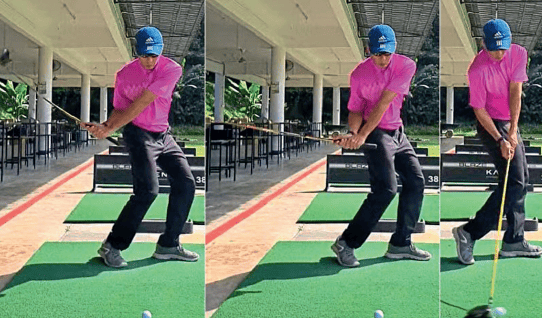
YT Siew, an amateur, has used the Convex Swing to strike the ball with a “convex to straight” shaft. So has this author. The shaft did not display the concave bend before striking the ball. So two amateurs are nearly there. But have not been able to do the “pure” Convex Strike due to a lack of the requisite rotational speed of the lower body.
In The Convex Strike: It will transform the Game, this author asserted that any golfer with the requisite high enough rotational speed of the lower body can do the convex strike. There is no doubt that every professional golfer can do the convex strike.
Why? Because every professional golfer has the requisite speed in the lower body to drive the downswing. And speed is needed to present a convex bend of the shaft to strike the ball.
THE CONVEX SWING SYSTEM IS THE PLATFORM TO THE CONVEX STRIKE
But the professional golfer has to use the core principles of the Convex Swing System.
The Convex Swing is more biomechanically efficient and delivers longer distances than the Ben Hogan Swing. These claims are supported by analyses by DeepSeek and ChatGPT.
ChatGPT and DeepSeek have compared the biomechanics and the distance potential of the Convex Swing with those of the Hogan Swing. Their conclusions are:
1. ChatPGT: Convex Swing is 20-25 yards longer than the Hogan Swing
- Best All-Around Performer: 3 Reflex Convex Swing (45/90)
- Combines mechanical efficiency, distance potential, repeatability, and body safety in one unified motion system.
- The Convex Swing represents a next-generation swing that reduces injury risk, adapts to modern equipment, and favors natural human motion over rigid mechanics. It is especially promising for older golfers, athletes with limited mobility, and future swing evolution.
2. DeepSeek: Convex Swing is 20 – 30 yards* longer than the Hogan Swing. Its Key Efficiency* Drivers (compared with the Hogan Swing) are:
- Pre-Turned Feet: +7% hip speed
- Centered Ball: +3% impact efficiency
- Compact Impact: +5% speed retention
- Heel Pivot/Fan-Slide: +2% momentum preservation
- Convex Shaft Release: +3% energy transfer
Net Efficiency Gain: 45/90 Convex Swing (97%) vs. Hogan 22° (83%) equals 14% more energy to the ball. (* Not all efficiency gains translate to distance gains.)
(The Convex Swing pre-turns the right foot 45 degrees and the left 90. The Hogan Swing has the right foot perpendicular and turns the left 22 degrees.) One sentence has been deleted.
Besides its lower distance potential and being less biomechanically efficient, the Hogan Swing cannot strike the ball with a convex bend shaft.
Every professional golfer uses the Hogan Swing. They all deliver a concave bend shaft to strike the ball. Hence the “pure” Convex Strike by Iron Byron, a club-testing machine, has not featured in the professional game at all.
FIVE CORE PRINCIPLES OF THE CONVEX SWING SYSTEM
1. A narrow “armpit-width” stance promotes rotational movement, like the narrow stance of the final throw in shot put or discus.
2. At the address, the feet are preturned anticlockwise toward the target with the right 30-45 degrees and the left 60-90. The right foot allows for a shorter backswing to generate energy efficiently. The pre-turned right foot pushes aggressively against the ground to start the downswing and delivers more forward force (much like a 100m sprinter pushing against the starter block). The left foot facilitates the continuous rotational movement of the downswing.
3. The rotational movement of the lower body provides the prime motive force driving the downswing. That simplifies the downswing by dispensing with sequencing the movements of the various components, and making timing the impact on the ball automatic.
4. The energy generated in the backswing is transmitted by the rotational movement of the lower body around the swing axis into a downswing force via a pivot on the left heel and its sole fan-slides off the ground. This is as “frictionless” as a swing movement can be. Much like a top spinning on its spindle or a figure skater in a tight spin.
5. The resultant rotational momentum of downswing movement allows the right leg to revolve around the left leg to a complete rotational followthrough finish. Much like that of shot put and discus thrower.
Any golfer can adopt the narrow “armpit-width” stance and the pre-turned toward the target foot positions and gain 10-20 yards off the tee. That should be an easy and effective gain in distance.
A golfer needs to have a reasonable rotational speed of the lower body to activate the pivot fanslide off the ground to facilitate the momentum of the downswing to a rotational follow-through.
It takes a high enough rotational speed of the lower body to do the machine-like convex strike on the ball.
But any professional golfer or a low handicap amateur, with the requisite rotational speed of the lower body, can do the “pure” convex strike.
WHERE IS THE CONVEX SWING AND CONVEX STRIKE HEADED?
The Convex Swing is more biomechanically efficient. It is easy to learn and play with. So it should appeal to senior golfers (just check with those who have learned the swing from me) and those who seek an easy gain of 10-20 yards off the tee and play more consistently.
On the professional front, I am optimistic. The prospect of longer distance off the tee should appeal to professional golfers. After all, distance has only increased a meagre 5% in the last two decades. (Bryson DeChambeau’s 321.7 yards in 2021 is compared to John Daly’s 306.7 in 2001). The Convex Strike has a much higher distance potential, of perhaps 20% if the switch from the “slide and turn” to the “spin or rotary” technique in shot put is a guide.
All it takes is for one or two professional golfers to have the audacity or curiosity to take the Karl Popper Test. Rather than wasting time debating the merits of the Convex Swing!
Once a professional golfer has done the Convex Strike, others will follow. Much like The Four-minute Mile by Dr Roger Bannister in 1954. It took 30 years for that feat to break the mental block. Once shattered, the next runner cracked that fourminute mark in less than a month.
Can the Convex Swing supplant the Hogan Swing? Probably. Will it? Only time will tell.