
Learning how to read greens is one of the most important lessons an amateur can learn, but some are oblivious to the key information that can be gathered on and around the putting surface.
When trying to improve their putting, using the best putting tips and drills, they often focus on other key areas like how to grip the putter or controlling speed on the greens – but at the expense of the crucial skill of green reading.

CLUE 1: HIGH POINT (PHOTO 1)
Reading a green starts way before you reach the putting surface, as there is so much information you can take in from the walk towards your ball. In the image below, I am looking for a few things – but initially I want to find the high point.
Once I can see the highest point of the green, I should be able to work out the direction that water would run. Here, the water would drain from the top right to the bottom left, so I already have an idea as to which way my putt could break.
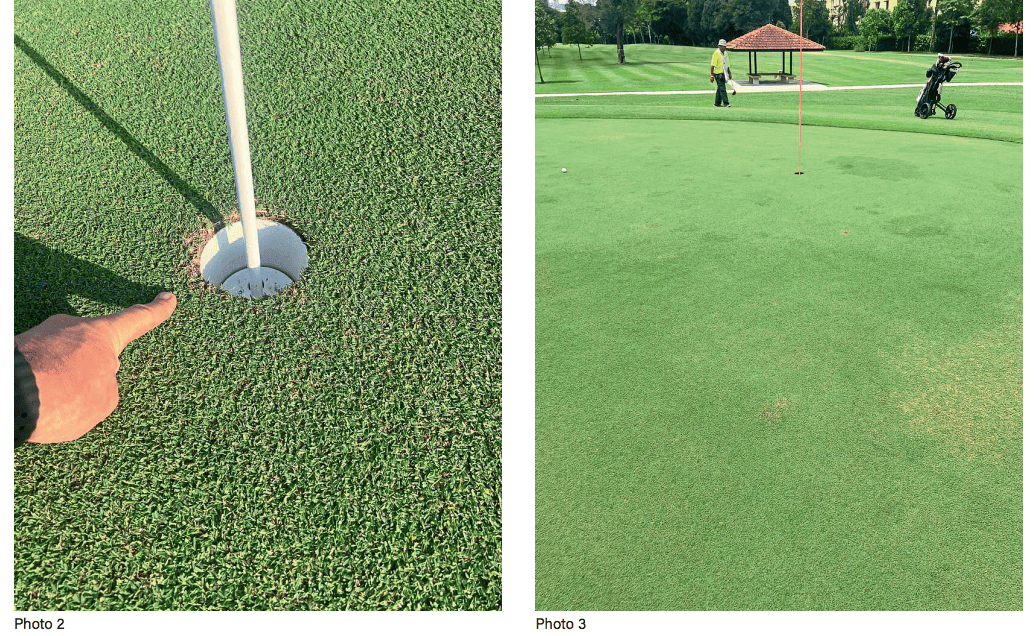
CLUE 2: GRAIN AROUND THE HOLE (PHOTO 2)
Analysing grain around the hole can provide key information. In the two images here, you can see one side of the hole has the grain towards it and the opposite side has the grain moving away from it.
CLUE 3: THE ‘SHINY’ SIDE (PHOTO 3)
When trying to read the green, it’s crucial to know whether you are putting into the grain or with it.
If the surface between your ball and the hole looks shiny, you’re putting with the grain, so the putt will be fast and will be key. If the green looks darker, it’s likely that you’re putting into the grain, so your putt is likely to be slower.
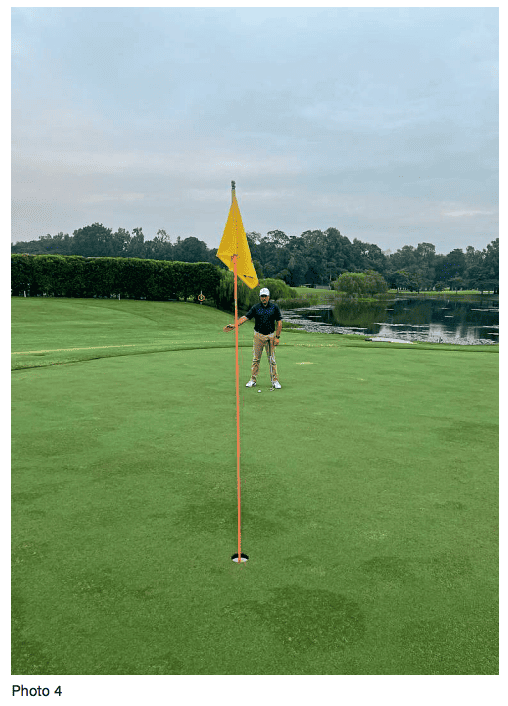
CLUE 4: BELOW THE HOLE (PHOTO 4)
You can see and feel the read of a putt better from below the hole. In this image I am using my feet and my eyes to analyse the break of my putt by assessing the slope, which will quite clearly move the ball from left to right.
I like to eliminate one side of the hole, so in this instance I know that there is no way this putt moves to the left. Taking one side out of play helps you to simplify the equation, making reading the green that little bit easier.
If you pay attention to these four pivotal green reading clues, I am confident you will limit costly three putts, give yourself a much better run at birdie attempts and ultimately shave a few shots off your round by avoiding simple mistakes.