Thus far, the Ben Hogan swing strikes the ball with a concave bend shaft. The shaft goes from a convex bend, to straight and then a concave bend shaft before it strikes the ball. Since the concave bend is weaker than the convex bend, it has limited the distance potential of every golfer.
In 2020, The Reflex Convex Swing postulated that the Convex Swing can present a convex bend of the shaft to strike the ball. The Convex Swing has five core principles that facilitate the continuous rotational movement of the lower body throughout the downswing. The resultant Convex Strike has the potential to deliver much longer distances, by perhaps 20 percent.

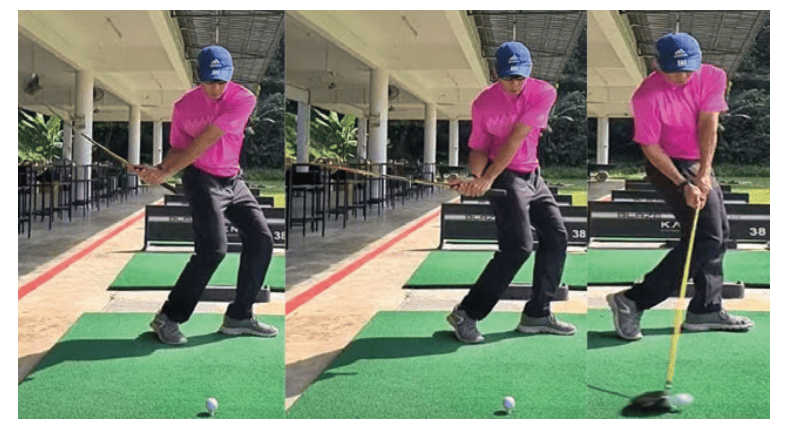
Between 2020 and 2024, an amateur, YT Siew, has learned to use the Convex Swing to strike the ball without the golf shaft transitioning to a concave bend. His “convex-tostraight” shaft strike has removed a mental block; it is now possible to strike the ball without the shaft transitioning to a concave bend. That strike is featured in The Convex Strike: It will transform the Game.
Here are three screenshots of the “convex-to-straight” shaft strike by YT Siew:
(At impact, the rolling shutter effect makes the shaft appear straight, rather than slightly convex.) Watch the video below.
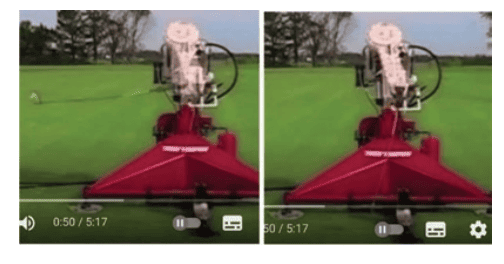
Here is the “pure” Convex Strike done by Iron Byron: https://youtu.be/-1Gr-vOA4sI (the video was posted on 11 Aug 2014). The shaft maintains the convex bend throughout the impact zone before it strikes the ball.
The left screenshot shows the convex bend shaft with the arm at the 6:30 position and the right at 5:45 with the clubhead about 6 inches from impact. The shaft has a convex bend throughout the impact zone.

ANY PROFESSIONAL GOLFER CAN DO THE CONVEX STRIKE
To emulate the machine-like “pure” convex strike, the golfer must have a high enough rotational speed of the lower body to retain the convex bend of the shaft throughout the impact zone before it strikes the ball. At no time does the shaft transition to a concave bend before it strikes the ball.
There is no doubt that every golfer, professional or amateur, with the requisite rotational speed in his lower body can use the Convex Swing to achieve the Convex strike.
Scottie Scheffler has that and much more. He already has three other movements: (1) the push of his left shoulder to maintain the obtuse left arm/shaft angle throughout the backswing, (2) an aggressive drive of his lower body to sustain the “lag” between the upper and the lower body before the shaft impacts the ball, and (3) the pivot on the left heel and the left sole fan-slide movement (albeit done incorrectly).
He seems amenable to adopt new measures to enhance his swing technique and distance off the tee. The “quirky” movement of his right leg at the finish of his swing is an example of his innovative approach to the golf swing.
Thus, he is most likely to be the first golfer to do the “pure” Convex Strike.
To achieve the convex strike, he needs to adopt several changes to his swing. A few are really easy to make; and some are simple variations of what he is already doing. The “rotational follow-through” movement, the culmination of the Convex Swing technique, is something that he has already done out of necessity.
So, for Scheffler, the Convex Strike is a “walk-through”1 in the park (pun intended). A gimme in golf.
ntended). A gimme in golf. Here is Scheffler doing the “walk-through” swing, done out of necessity: (Note that the right leg crosses the left in the last two screenshots.)
Scheffler’s “walk-through” is close to YT’s rotational follow-through movements:
YT is more balanced, pivoting on the left heel throughout the downswing. Those movements are done by design.
WHAT DOES SCHEFFLER NEED TO DO?
To do the Convex Strike, Scheffler needs to adopt some if not all the core principles of the Convex Swing.
Two are static changes at the address, another is to improve on what he has already been doing and one other is something he has done out of necessity.
The changes that Scheffer needs to adopt are briefly listed as follows:
1. At the address, adopt the “armpit-width” stance. (This is about six inches narrower than the Hogan swing stance.)
2. At the address, pre-turn both feet anticlockwise toward the target, the right foot 30-45 degrees and the left 60-90. (The right foot position of 30-45 degrees shortens the backswing without compromising the generation of energy for the swing. The preturned right foot is also more effective in transferring more rotational force in the target direction. The very open left foot does not block the momentum of the downswing. The foot positions facilitate the anticlockwise movement of the downswing.)
3. In the backswing, push the left arm/shaft back with the left shoulder and maintain the obtuse left arm/shaft angle until the top of the backwing is reached. Focus on folding the right arm as soon as the left shoulder starts pushing. (When the right arm/wrist remains passive throughout the backswing, the left arm remains close to the left chest, and the left arm and shaft remain on a circular arc that points left of the target line. At the top of the backswing, the left arm covers the right shoulder when viewed down the line. This swing plane does not require any conscious change to be made in the downswing; it is a one-plane swing.)
4. In the first move downswing, push off the ball of the right foot and rotate the lower body to drive the downswing and transfer the body weight onto the left heel. (Avoid shifting the body weight onto the ball of the left foot. Pivoting and rotating on the ball of the left foot is not efficient and must be avoided.)
5. Throughout the impact zone, continue to rotate the lower body by pivoting on the left heel and allowing the left sole fan-slide open off the ground. (This pivot fan-slide movement allows the momentum of the downswing to retain the convex bend in the shaft until it impacts the ball with a convex bend shaft.)
6. At past impact and beyond, continue to rotate the lower body by pivoting on the left heel and fan-sliding the sole off the ground, and allowing the right leg to cross over the left on the follow-through momentum of the downswing. (In the rotational follow-through, 2 the extent of the crossover depends on the trade-off between accuracy and distance. For maximum distance, the right foot can land about 90-180 degrees across the target line. For accuracy, the right foot can land about 0-90 degrees beyond the target line.)
The above movements ensure that the Convex Strike 2 occurs every time. Those movements can be executed readily by Scheffler, and if he adopts them, several outcomes will follow:
- He will become the first human golfer to emulate the “pure” Convex Strike, first performed by Iron Byron, a club-testing machine.
- He will transform the game of golf for perpetuity because there is no third way to bend a shaft. And the convex bend is the stronger bend.
- The Convex Strike is the ultimate arbiter of distance. And the perfection point in golf.
- Like the “four-minute mile” by Roger Bannister, Scheffler’s Convex Strike will become commonplace in the professional game.
- Like the “Fosbury Flop” in high jump, the Convex Swing is more biomechanically efficient. It will not look strange until it is commonplace.
Now, any golfer can adopt the Convex Swing and gain 10 – 30 yards off the tee!
1.) The “walk-through” swing is something that Scottie Scheffler has done in the 2022 Masters. That follow-through was a result of the momentum of the powerful rotation of his lower body accentuated by the downslope on which the shot was played. It was done out of necessity. Here it is: https://youtu.be/ FGOZM2QRKyY?si=1dNVZJGZjGRTl18V Watch it at the time: 0:06-0:10, 0:16-0:18, 0:28-0:31 and 0:32-0:35.
2.) The rotational follow-through of the Convex Swing is done by design. Each element of the Convex Swing trades-on the preceding element sequentially. The rotational follow-through is the culmination of all the movements that make up the Convex Swing. Hence, the Convex Swing can deliver significantly longer distances.
Comments are welcome at saifahcheong@gmail.com