From framing fairways to masking eyesores, trees are key to both playability and aesthetics. Trees are often admired for their beauty on the golf course, providing colour, texture, vertical interest, and year-round visual appeal. But to view them solely as aesthetic elements would be to overlook their full utility. Trees play critical, functional roles in course design and maintenance, and a deeper understanding of their purposes can help superintendents and designers enhance the overall golf experience. One of the best ways to evaluate a tree’s value on the course is to ask a simple question: “What is it there for?”

BACKDROP TREES: ENHANCING VISIBILITY WITHOUT COMPROMISING TURF HEALTH
As golfers prepare to strike an approach shot from the fairway or tee off on a Par 3, their ability to judge the distance to the flag becomes critical. One subtle but important aid in this visual assessment comes from trees positioned alongside and behind the green.
For example, at Hole 6, New Course, a massing of large trees forms an effective backdrop, while the Rain Tree at Car Park A frames the view of Hole 9, New Course Green.
These backdrop trees serve several functions:
• Enhancing flag visibility – The movement of the flag is more easily read against the contrast of leaves, trunk, or silhouette.
• Improving depth perception – They create separation between turf zones, making distinctions from fairway to fringe to green more defined and meaningful.
However, the question remains: “How close should backdrop trees be to the green?” Placement requires careful balance. While trees must be close enough to offer visual benefits, they must also remain far enough to avoid compromising turf health, particularly for sensitive species such as bermudagrass, which is highly vulnerable to shade stress, thinning, and disease pressure.

When selecting and positioning backdrop trees, several considerations apply:
• Canopy density: Dense canopies cast heavier shade and reduce airflow.
• Debris management: Excessive leaf, fruit, or twig drop burdens maintenance and affects putting surfaces.
• Species characteristics: Deciduous and evergreen species impact seasonal light levels and maintenance needs differently.
The goal is always to maximise visual benefit while minimising agronomic impact.

DEFINING DOGLEGS: USING TREES TO CLARIFY DIRECTION AND STRATEGY
While backdrop trees aid with depth perception, trees placed at or near doglegs serve an entirely different purpose, to visually signal directional change and influence shot strategy.
A well-placed single tree or grouping can guide a golfer’s eye and decision-making by clearly indicating where the fairway transitions. This reduces uncertainty from the tee and subtly communicates whether a hole bends left or right.

Examples at RSGC include:
• Hole 13, New Course: Trees on the left signal the turn towards the green.
• Hole 16, New Course: A similar cluster provides directional cueing and boundary definition.
Effective placements for doglegdefining trees include:
• At the beginning of the curve: Signalling the start of the directional shift.
• On the opposite side of the fairway: Reinforcing the angle visually and creating a reference target line from the tee.

These trees function much like natural road signs, helping golfers anticipate the layout without the need for artificial markers. When thoughtfully placed, they become an elegant strategic element, shaping shot-making decisions and enhancing course flow.
SCREENING TREES: BLOCKING NOISE AND VISUAL DISTRACTIONS
Among the most practical roles of trees on the course is their function as natural screens, both visually and acoustically. Notable examples include:
• Hole 11, New Course: Trees help buffer sights and sounds from Horizon Apartments, RHB Building, and TREC.
• Hole 6, New Course: Plantings help block traffic noise from the Tun Razak Expressway.
BENEFITS OF SCREENING TREES INCLUDE:
• Noise reduction: Thick, layered canopies help dampen disruptive sounds from roads, buildings, and neighbouring activities.
• Visual concealment: Trees shield unsightly structures, preserving the tranquillity and visual integrity expected on a premier golf course.
• Aesthetic cohesion: When designed intentionally, screening trees do more than hide, they contribute to a cohesive, curated landscape view.
By carefully selecting species with dense foliage and height capacity, screening trees enhance the golfer’s sense of immersion, creating a more serene and focused atmosphere throughout play.

SIGNATURE TREES: IDENTITY, MEMORY, AND STORYTELLING
Just as a signature represents individuality, a signature tree can become a defining emblem of a golf course, memorable not just for its form, but for its story. At RSGC, examples include:
• The striking Rain Tree between Hole 6 Old Course and Hole 13 New Course.
• The Mahogany Tree at Hole 14, Old Course, known for its exposed root formation.
• The iconic Rain Tree at Car Park A, often admired by Members and guests upon arrival.
Signature trees may hold value for several reasons:
• Historical significance: Some were preserved from the course’s early development.
• Symbolic identity: Courses named after tree species often showcase those trees prominently to reinforce brand character.
• Emotional connection: Trees near clubhouses, entrances, or scenic vantage points become part of Member culture and tradition.
Common placements for signature trees include:
• Entrance roads: Offering a symbolic welcome.
• Near the clubhouse: Becoming a landmark for gatherings and photography.
• On-course focal points: Recognised by regulars and guests as part of the course’s “character”.
A signature tree need not be rare or ancient, it simply needs presence, story, and memorability
PROTECTION TREES: ESSENTIAL IN TIGHTER COURSE LAYOUTS
Golf course layouts vary, some offer expansive fairway corridors, while others feature more compact designs where the proximity between holes increases safety considerations. In tighter layouts, protection trees become critical.
Their primary roles include:
• Creating separation between adjacent fairways: Preventing errant shots from crossing into neighbouring play areas.
• Enhancing safety for golfers and spectators: Acting as a natural barrier against stray balls.
• Defining the playing corridor: Guiding shot selection and promoting disciplined play.
Examples at RSGC:
• Between Hole 1, New Course and Hole 10, Old Course, a line of False Ashoka trees acts as a buffer.
• Along Hole 9, Old Course, a raised line of Eugenia trees shields views of the water tank and Staff Building, serving both protection and screening purposes.
In more open course designs, such protection may be less necessary. However, on tighter sections, protection trees are essential for maintaining both safety and visual order, ensuring that each hole feels intentional, selfcontained, and thoughtfully framed within the landscape.
TREES AS STRATEGIC OBSTACLES: ENHANCING CHALLENGE THROUGH DESIGN
Every golf hole carries an intentional degree of difficulty, shaped by the course’s philosophy and the type of players it caters to, from casual public layouts to refined member clubs like RSGC. Here, trees are not merely passive scenery but active strategic elements.
Well-placed obstacle trees can influence how golfers approach a hole:
• Shaping shot trajectory and landing zones
• Rewarding accuracy while penalising deviation
• Forcing players to think rather than simply swing
Examples at RSGC include:
• Hole 11 and Hole 12, Old Course — The positioning of Khaya trees on the right forces players to avoid that line and manage ball flight more deliberately.
When utilised thoughtfully, trees become part of the course architect’s strategic language, adding layers of challenge, encouraging precision, and creating memorable moments of decision-making across the round.
SAFETY FIRST: REGULAR INSPECTION OF OBSTACLE AND DIRECTIONAL TREES
Trees located close to lines of play — especially those used as strategic or directional markers — require proactive safety management.
For example:
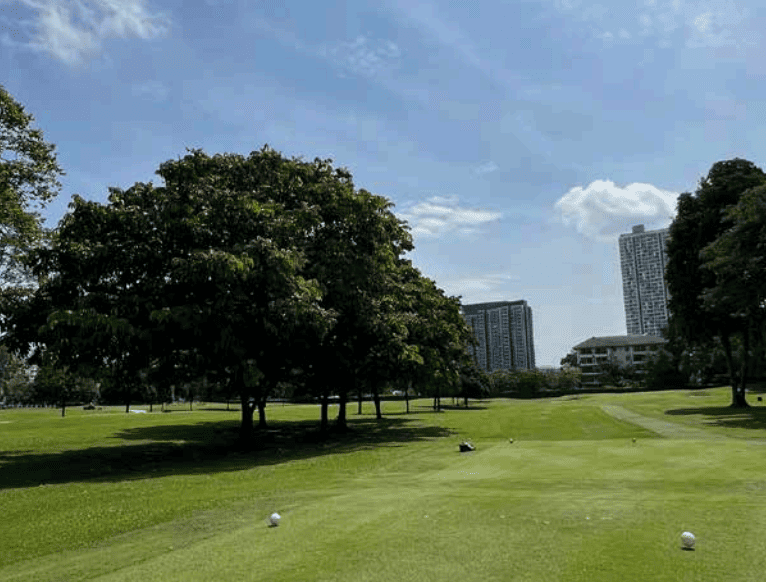
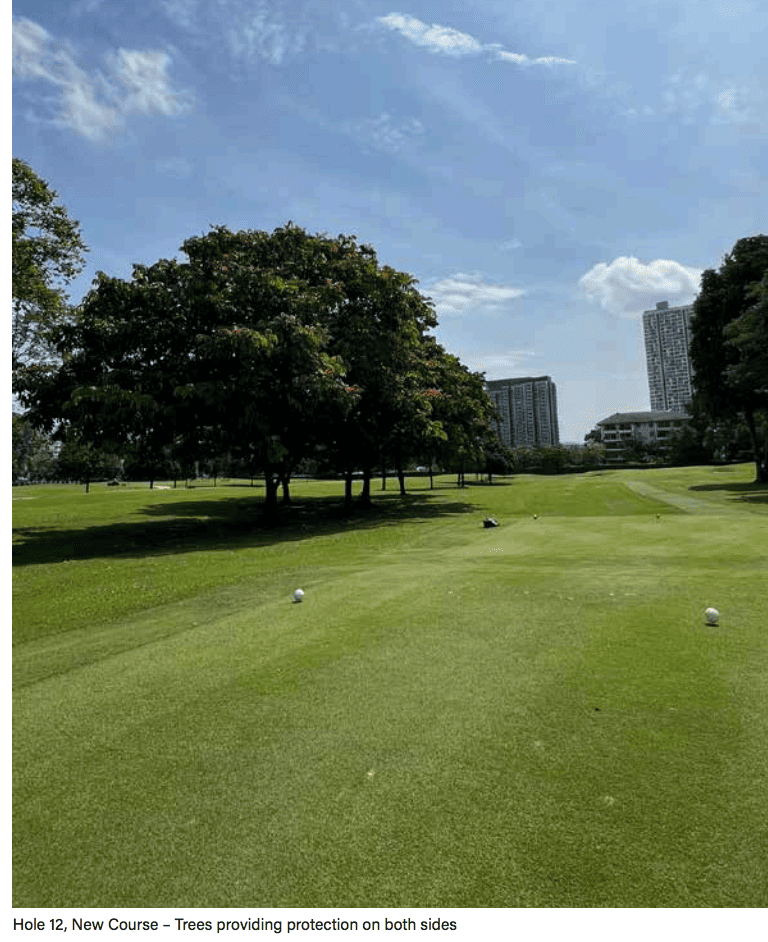
• At Hole 12, New Course, trees direct shots toward the green while shielding players crossing on the right and those teeing off at Hole 16, New Course.
• At Hole 9, New Course, trees on the left prevent balls from deflecting towards the main road and Car Park B.
To ensure safety and structural integrity:
• Routine inspections by an ISAcertified arborist (International Society of Arboriculture) are vital.
• These checks help identify weak limbs, disease, decay, or instability before they pose a risk to Members, staff, or property.
• Preventive care preserves both safety and aesthetic value, ensuring that trees continue to serve their purpose without NATURE becoming hazards. Effective tree management is not just landscape care, it is a safety protocol.
SHADE TREES: COMFORT BEYOND THE COURSE
One of the most fundamental contributions of trees on a golf course is shade, particularly in nonplaying areas such as: • Clubhouse surroundings
• Outdoor dining terraces
• Refreshment huts and halfway stops
• Rest shelters and restroom facilities
At The Royal Selangor Golf Club, many mature trees significantly enhance comfort around social and resting areas. Beyond aesthetics, shade trees reduce ambient temperature and glare, creating a more pleasant environment for Members, caddies, guests, and staff. These shaded rest points encourage longer stays and increase overall enjoyment of club facilities.
Given their impact on Member experience, the placement and maintenance of shade trees should be considered a key design component, not merely a landscaping detail.
FRAMING TREES: DEFINING AND HIGHLIGHTING KEY FEATURES
Just as a picture frame enhances a portrait, framing trees elevate the importance of architectural and landscape features across the course.
Common framing locations include:
• Clubhouse approach and reception zones
• Arrival vistas and main walkways
• Event and gathering points such as terraces or ceremony lawns A classic and effective technique is planting two or more specimens of the same species symmetrically.
One on each side, to draw the eye and create a sense of arrival or significance. When a stronger visual emphasis is required, trees can be massed to form a natural archway or living border.
Thoughtful framing enhances aesthetics, contributes to a sense of place, and subtly communicates hierarchy. Guiding visitors’ focus to key features without the need for hard structures or signage.
HABITAT TREES: LEGACY AND WILDLIFE VALUE
Not all valuable trees are living. Standing dead trees, when structurally safe, serve an important ecological role and should not be removed automatically.
At Hole 17, Old Course, habitat trees support native birdlife, including raptors and songbirds. These trees offer:
• Perching and nesting opportunities
• Shelter zones free from frequent play
• Biodiversity enrichment within a managed landscape
Retention is appropriate only when located in low-risk, non-play areas, such as the undisturbed zone between Hole 4 and Hole 6, Old Course. As always, stability checks by an ISA-certified arborist are essential before designating a tree for habitat purposes.
Preserving such trees adds environmental value and storytelling depth, positioning the course not just as a recreational facility but as a steward of its natural heritage.
REEVALUATING TREE FUNCTIONS: A HOLISTIC MANAGEMENT PERSPECTIVE
As you reflect on the diverse roles trees play across RSGC golf course, it becomes clear that a single tree can serve multiple functions, visual, strategic, ecological, or protective. While others may fulfil just one.
This layered complexity highlights the importance of regular assessment and strategic decisionmaking in tree management. Whether conducted formally on a hole-by-hole basis or through ongoing observation, these evaluations enable management to:
• Preserve trees that offer critical benefits
• Identify trees that conflict with turf health or safety
• Communicate decisions clearly and confidently to stakeholders
By adopting a functional mindset, and always asking “What is it there for?”. Superintendents and decisionmakers can ensure that tree management supports playability, safety, identity, and environmental stewardship.