
Club golfers typically don’t spend enough time at the driving range, but on the occasions that they do, I often observe a familiar pattern of poor decision-making that wastes their precious practice time.
If you are serious about improving your golf game, it’s crucial to avoid these seven common habits that stall progress and leave you feeling less confident than when you arrived.
1. ARRIVING WITHOUT A PLAN
Too often, golfers come to the range with no real plan, simply hitting balls without any thought or purpose.
The usual approach? Grab the driver immediately, bang balls endlessly, and hope something magically improves.
I want you to go to the range with a plan. You should know exactly what you’re working on before you hit your first shot.

2. THE “MACHINE-GUNNING 50 BALLS” APPROACH
Can smashing 50 balls in ten minutes make you a better golfer?
Absolutely not.
Yet many golfers adopt this frantic, rapid-fire approach.
Instead, I want you to “play golf” as much as possible on the range. Less is more.
One of my favourite drills only requires three golf balls:
• Place three balls in front of you.
• Give each shot your full attention.
• Step away each time and go through your pre-shot routine.
• Step back in, focus on your intention, and execute. Repeat this with patience and purpose, the results will come.
3. JUST GUESSING WHAT’S HAPPENING
Most golfers don’t record their swing on the range, relying solely on feel rather than what is actually happening.
Stop guessing. Set up your phone or camera at belt height, directly down the line, pointed straight through your hands at address.
Use slow motion. Hit a few balls following your planned routine.
Review the footage every few shots, you’ll be amazed how much you learn from this simple practice.
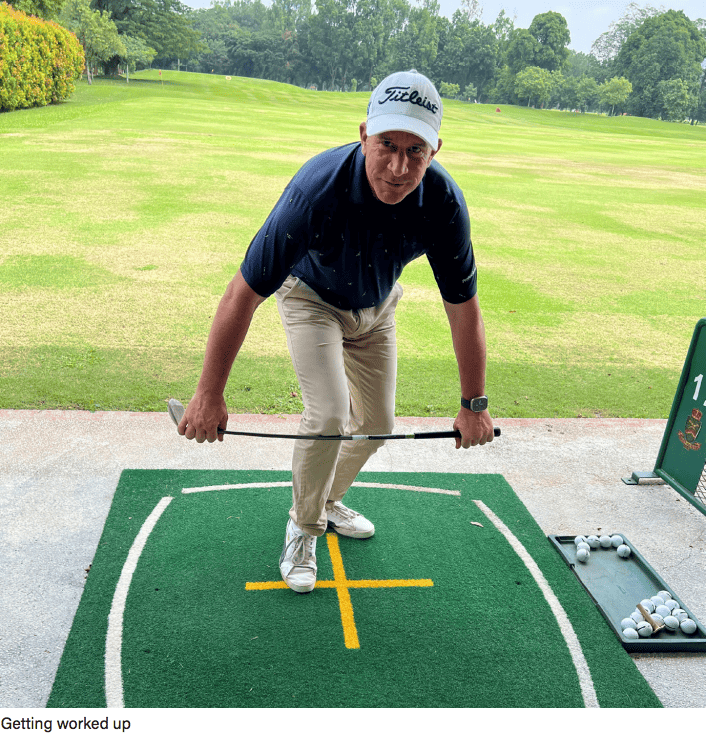
4. GETTING WORKED UP
It genuinely doesn’t matter if you’re hitting it badly on the range, this is a safe space to work on your game.
Practice can become one of the most frustrating parts of golf if you let emotions take over. Allow yourself the time and patience to make mistakes while working on technical changes.
Too often, golfers try to show off, calling friends over only when they strike a perfect shot. But that isn’t improvement.
When you are working on technique, you will get things wrong. That’s normal.
If your long-term goal is to improve, enjoy the process, and give yourself a break.
5. NEGLECTING CLUBFACE DRILLS
Clubface control is the most important element in controlling the golf ball, yet many golfers spend almost no time on it.
Try this simple drill:
• Hit three balls to three different directions:
• First: as far left as possible
• Second: as far right as possible
• Third: straight down the middle
Each time, feel how much the clubface needs to open or close to produce the shot. It may look strange to others, but who cares?
Understanding the extremes helps you find the centre more consistently.
6. RELYING ON SHOT FEEDBACK FOR DISTANCE CONTROL
Short-game practice only works if you do it correctly.
A common mistake:
A golfer aims at a 40–50 yard target.
They hit the first shot long, the second short, and the third exactly right.
It feels like progress — but it isn’t. Your brain is simply reacting to the previous shot.
On the course, you don’t get that luxury.
For proper distance control:
• Practise randomly.
• Change targets frequently.
• Go through your full routine for each shot.
If you’re working on technique, then you can stick to one target — otherwise, keep it random.
7. ONLY FOCUSING ON DRILLS
Drills are important, but they are not the golf swing.
Many golfers become excellent at drills yet struggle to transfer those movements to a full swing.
That’s why you must alternate: • One swing using the drill • One full, normal swing Use the drill to learn. Use the swing to assess.
Also vary your swing speeds, from slow to fast.
If you can’t do the movement slowly, you won’t achieve it at full speed.