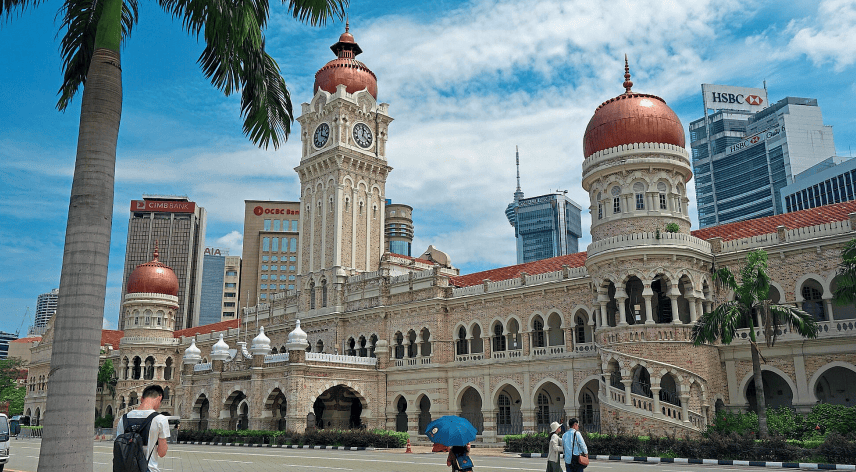
The recent reopening of Bangunan Sultan Abdul Samad (BSAS) marks a significant milestone for Kuala Lumpur’s historic core. Following the completion of Phase 1 conservation works, the landmark once again opens its doors to the public, not simply as a restored monument, but as a reactivated civic space with renewed purpose.
Somewhat ironically, the building which is today one of Malaysia’s most admired and iconic structures was never meant to be such an important piece of built heritage. Originally conceived simply as the Government Offices, the building was designed to meet the practical administrative needs of a fastgrowing colonial capital rather than to serve as a lasting symbol.
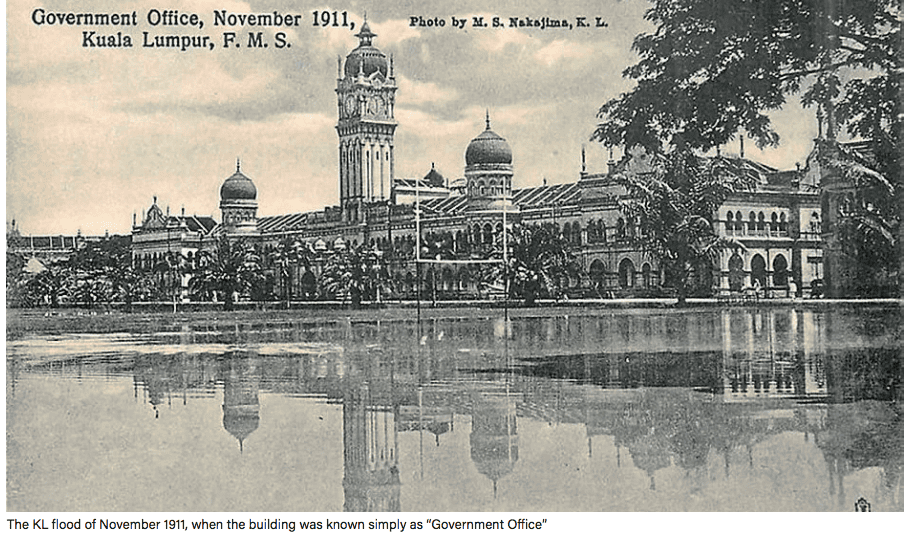
When it opened in 1897, it housed a range of government departments and functioned as a working bureaucratic centre, not a monument. Its prominence and iconic status emerged only over time, shaped by its location facing the Padang and its role in key moments of national history. The building was officially renamed Bangunan Sultan Abdul Samad in the late 1970s, following Kuala Lumpur’s designation as a Federal Territory and a major restoration programme, reframing a utilitarian government complex as one of the country’s most recognisable historic landmarks.
The ceremony to mark the completion of the building’s latest revival and renewal was held on 31 January 2026, placing BSAS firmly within the broader Warisan KL initiative – a national, heritage-led urban renewal programme that seeks to do more than preserve historic buildings. Instead, Warisan KL aims to restore relevance, improve liveability, and create sustainable opportunities across tourism, culture, and communitybased enterprise.
BSAS is the second major building to be revitalised under this umbrella, following the launch of Seri Negara in December. Both projects reflect a wider commitment, led by Khazanah Nasional and its partners, to return some of Kuala Lumpur’s most important historic structures to active public use after years of limited access.
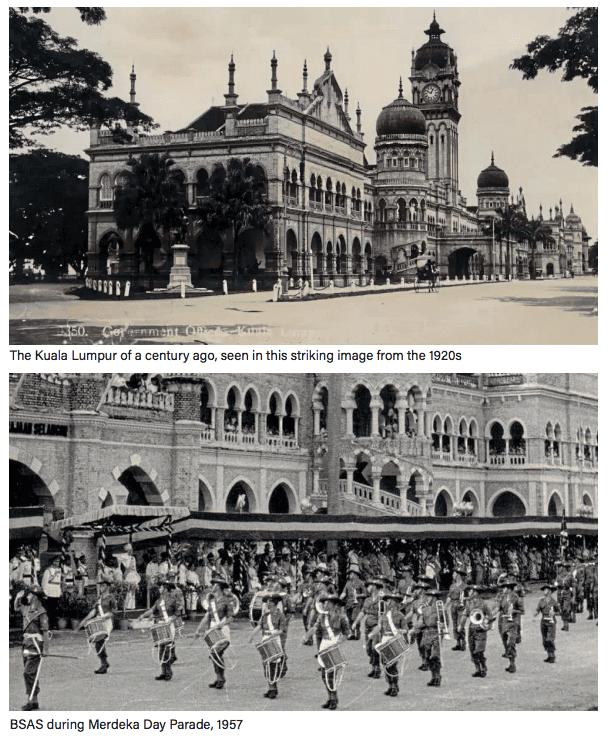
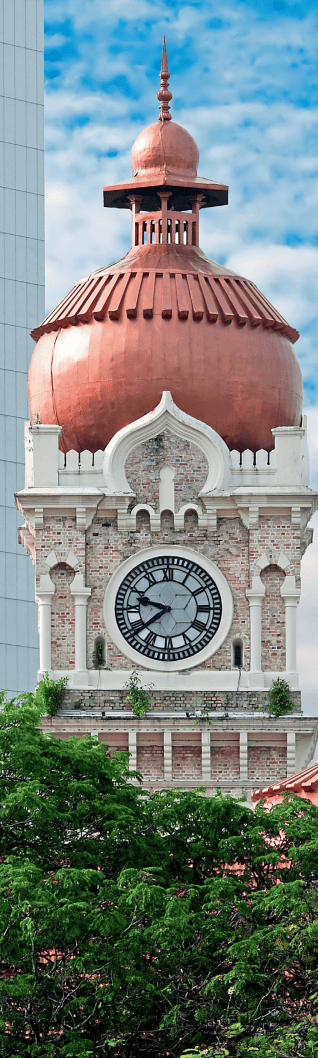
Facing Dataran Merdeka, BSAS has long occupied a central place in the city’s visual and symbolic landscape. Its copper domes and clock tower have watched over Kuala Lumpur’s political, social, and civic life for more than a century. Yet for much of that time, the building functioned primarily as a working administrative and judicial space rather than a public destination.
FROM COLONIAL ADMINISTRATION TO NATIONAL MEMORY
Completed in 1897, Bangunan Sultan Abdul Samad was originally conceived as an emblem of British colonial authority. It housed Selangor’s state administration and later various federal departments, anchoring Kuala Lumpur’s early role as a centre of governance. Over time, as the city evolved and Malaysia moved towards independence, the building’s meaning shifted alongside the nation itself.
On the night of 31 August 1957, BSAS became the backdrop to one of the most defining moments in Malaysian history, when the Union Jack was lowered and the Malayan flag raised for the first time. In the decades that followed, its image was etched into public consciousness through Merdeka Day parades, school textbooks, and televised broadcasts, transforming it from a colonial structure into a cherished national landmark.
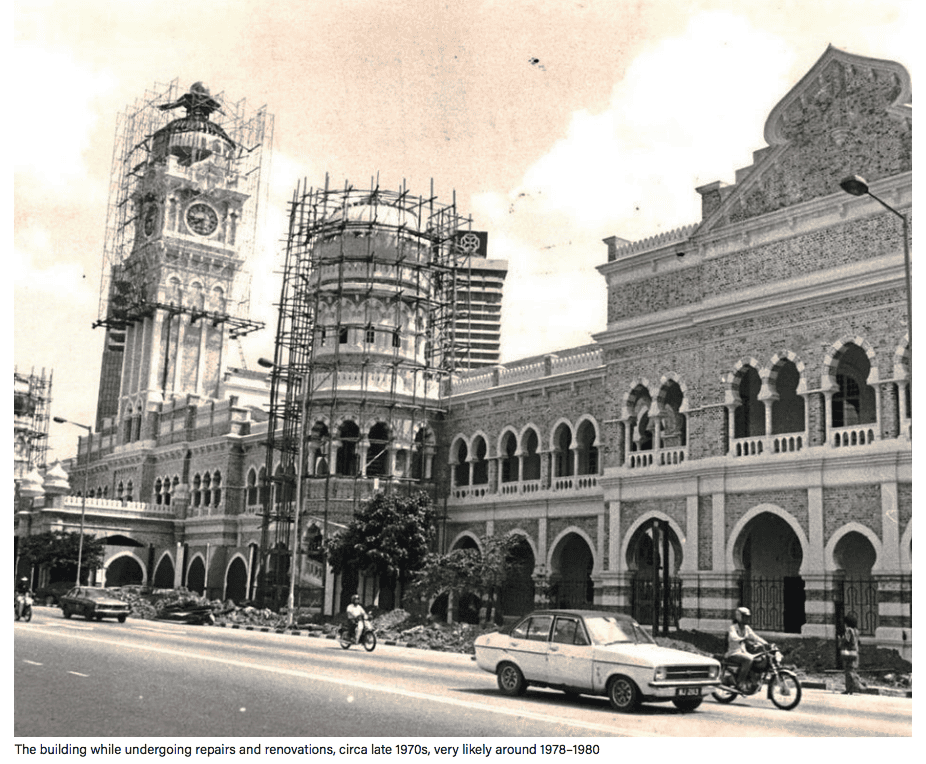
Despite its prominence, the building was never designed as a monument to be admired from afar. For much of its life, it was a place of work, decision-making, and routine. This was especially true after 1978, when BSAS was handed over to the judiciary following the formation of the Federal Territory of Kuala Lumpur and Selangor’s administrative move to Shah Alam.
From the early 1980s until the mid-1990s, BSAS housed the Federal Court and High Court, later joined by the Court of Appeal. Legal proceedings, registries, and chambers occupied its upper and lower floors, embedding the building deeply into the daily functioning of Malaysia’s justice system.
Retired Court of Appeal judge Tan Sri Datuk V.C. George, whose legal career spanned the postindependence years, recalls the building’s transformation from administrative offices into a judicial complex. He was elevated to the High Court Bench in the early 1980s and returned to Kuala Lumpur just as the courts were relocating into BSAS.
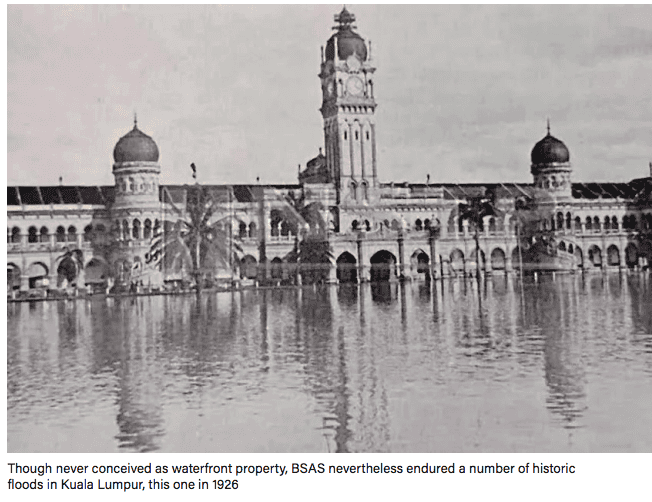
He has described the building as both imposing and practical, noting its strategic position facing the Padang and its proximity to institutions such as the Selangor Club and St Mary’s Church. The layout, he observed, reflected a colonial urban logic that placed work, governance, and social life in close balance. When the courts eventually moved out, he admitted it was difficult to see such a significant building left largely unused for so many years.
For those who worked in and around the courts, BSAS was never static. Photojournalist Kamarul Ariffin Hassan, who covered court proceedings there during his early career, remembers the building as a tightly controlled environment where tension often ran high. The architecture, however, left a lasting impression.
He has spoken of the natural light, the arches, and the way space shaped movement, particularly during high-profile trials. For him, the building’s value lies not only in its facade, but in its interior experience. He has argued that conservation should go hand in hand with access, allowing people to move through the space rather than simply photograph it from outside.
A similar sentiment is echoed by Saras Manikam, who served as a Tamil court interpreter at BSAS throughout the 1980s and early 1990s. She has described the building as having a distinct presence, one that conveyed history the moment staff stepped inside. Her work took her between chambers and courtrooms, interpreting proceedings in cases that reflected the diversity of Malaysia’s legal landscape.
Beyond the courtroom, BSAS was also a front-row seat to national life. Each year, Merdeka Day parades passed directly outside, often bringing proceedings to a halt as staff, lawyers, and judges stepped onto balconies to watch. These moments, woven into daily routine, reinforced the building’s role as both a workplace and a witness to history.
A HERITAGE ASSET RETURNED TO PUBLIC LIFE
After the courts relocated to Jalan Duta in the mid-1990s and later fully vacated the building, BSAS entered a quieter phase. Stewardship passed to heritage custodians, including Jabatan Warisan Negara and Aset Warisan, but public access remained limited.
According to Mariana Isa, Senior Manager for Culture-based Economic Development at Think City, this long period of restricted access shaped public perception. Unless someone had official business, there was little reason or opportunity to enter the building. Its presence remained strong visually, but its interior life faded from collective experience.
The current conservation effort represents a deliberate shift away from that pattern. Under Warisan KL, restoration is paired with long-term planning around use, management, and programming. The aim is not only to preserve architectural fabric, but to ensure that heritage buildings remain active, relevant, and economically sustainable.
The timing of BSAS’s recent reopening, coinciding with Federal Territory Day, carries symbolic weight. As an icon of Kuala Lumpur’s administrative past, returning the building to the public reinforces its place within the city’s evolving identity.
With Phase 1 complete, visitors can now experience the architecture and spatial qualities of BSAS firsthand. The reopening invites people to move beyond viewing the building as a distant symbol and to engage with it as a lived space shaped by governance, labour, and everyday moments.
The broader ambition of Warisan KL is to demonstrate how heritageled renewal can support urban life rather than freeze it, an approach that should be embraced. By working collaboratively with public and private partners, governmentlinked companies, and key agencies, the programme seeks to balance conservation with activation.
As BSAS re-enters public life, it does so carrying layers of meaning – colonial administration, independence, judicial authority, and now, cultural reconnection. Within its walls are echoes of decisions made, cases argued, and routines repeated over decades. To step inside today is to encounter those layers and to recognise that Kuala Lumpur’s heritage is not only something to remember, but something to experience.
Sources: WarisanKL.my, Malay Mail, Wikipedia, abhubback.com, kl.kehakiman.gov.my
AT A GLANCE: ARCHITECTURE AND CONSTRUCTION Bangunan Sultan Abdul Samad was designed and constructed between 1894 and 1897, at a time when Kuala Lumpur was emerging as the administrative centre of British Malaya. Construction began on 3 September 1894, with the foundation stone laid a month later by Governor Sir Charles Mitchell. The building was officially opened on 4 April 1897, by Resident-General Frank Swettenham.
The project was led by State Engineer C.E. Spooner, who acted as both designer and supervisor, working alongside Selangor Public Works Department architect A.C.A. Norman. R.A.J. Bidwell developed much of the early design before leaving for Singapore in 1895, after which A.B. Hubback continued refining the structure and later contributed to extensions. The main contractor was Towkay Ang Seng.
Construction costs were recorded at between 152,000 and 153,000 Straits dollars. In present-day terms, this is broadly equivalent to an estimated RM11–13 million, reflecting both late-19th-century currency values and long-term inflation. The scale of materials used was substantial, including approximately four million bricks, 2,500 barrels of Portland cement, 18,000 pikuls of lime (a pikul is a traditional unit of weight equivalent to roughly 60 kg), 5,000 pounds of copper, 50 tons of steel and iron, and around 30,000 cubic feet of timber.
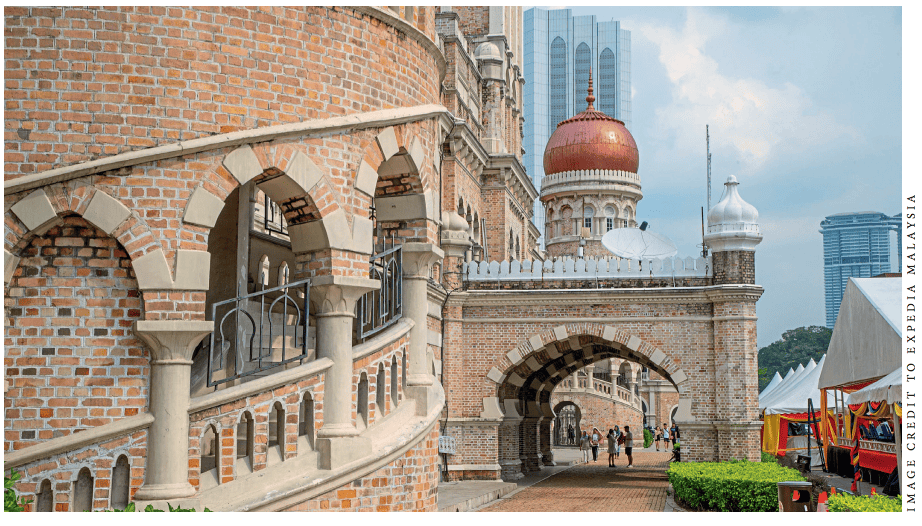
Architecturally, the building is a prominent example of Mughal Eclectic or Indo-Saracenic design. It features an asymmetrical F-shaped plan, with two-storey wings wrapped by arcaded verandas on both levels. A wide range of arch forms were employed, including pointed, ogee, horseshoe, multifoil, and four-centred arches, highlighted by imitation stone dressings. Indian patent stone with Islamic geometric patterns was used extensively in the flooring.
The central clock tower rises to approximately 41 metres and is flanked by two smaller circular turrets containing spiral staircases inspired by Muir Central College in Allahabad. Copper-plated domes crown the towers, topped with guldastas and detailed with Hindu-influenced elements such as lotus motifs, kalash-style finials, and a chattri cupola. The clock itself, fitted with a one-ton bell striking every hour and half-hour, was manufactured by Gillett & Johnston of Croydon.
Over time, structural adaptations were made to strengthen the building due to its proximity to the river and exposure to vibrations from daily signal guns. Minarets were removed as an air-raid precaution during 1939–40, and the clock tower was damaged during a 1941 air raid. Later alterations included its conversion into a courthouse in 1988, reflecting the building’s ability to adapt while retaining its distinctive architectural identity.