Any leaks arising, “my head (Razak) will roll and if mine goes, yours will follow”
GANYANG MALAYSIA
Four months prior to the homebound sailing of the KD Sri Kelantan and KD Sri Terengganu from Portsmouth on 16th Dec 1963, two major events of national significance unfolded – the formation of the Federation of Malaysia on 16th September and soon after “Ganyang Malaysia”, Indonesian President Sukarno’s threat to crush Malaysia- severely testing the new born Federation’s security and defence capabilities and resources.
The Confrontation saw infiltrations, armed attacks, acts of subversion, skirmishes on the high seas and land, including landings of Indonesian paratroopers on the south-west coast of Johor in August, resulting in both sides suffering casualties.
Two of Thanabalasingam’s fellow officers from the batch of 1955 would see action. Lieutenant P.K. Nettur’s vessel had an encounter off St John’s Island, Singapore, on July 24th 1964, while Lieutenant M.W. Alvisse’s ship came under attack while patrolling off Bedok, Singapore, on December 1, 1964.
Both officers acted valiantly and were awarded the KPK (Kepujian Perutusan Keberanian) for their gallant effort.
There were serious encounters in the jungles of Sabah and Sarawak, which the army had to repel with support from the British, Australian and New Zealand forces.
The infiltrations and attacks ceased following a coup in Indonesia in September 1965, resulting in the toppling of Sukarno. A Peace Agreement was finally signed on 11th August 1966 by the Deputy Prime Minister cum Defence Minister, Tun Abdul Razak and the Foreign Minister of Indonesia, Adam Malik.
KD HANG TUAH
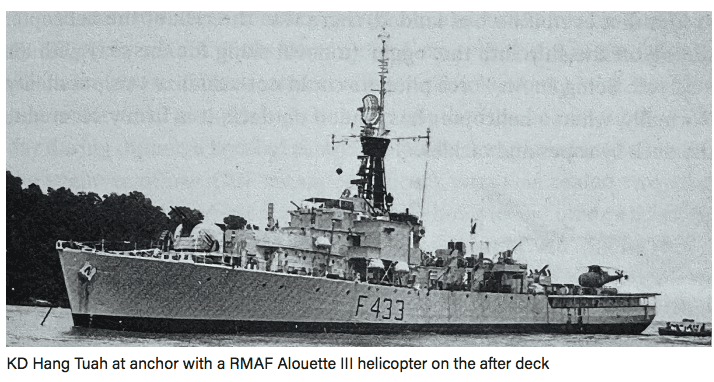
The history of KD Hang Tuah goes back to January 1944, when it was first launched as HMS LOCH NISH. It was a LOCH class anti-submarine warfare (ASW) frigate, “Designed to enhance operations against submarines.”
KD Hang Tuah was transferred to RMN, followed by extensive retrofitting and commissioned in Portsmouth on October 2, 1964. It was Malaysia’s first frigate. She arrived in Singapore on December 30, 1964 and was immediately deployed on “anti-confrontation patrol duties” with First Lieutenant Thanabalasingam serving as the Executive Officer (“XO”) with the rank of Lieutenant Commander, second in command to the Commanding Officer, Commander M.J. Mann.
As the XO, he was tasked with the total operation of the ship. KD Hang Tuah would serve as the flagship while conducting its patrolling duties in the Malacca Straits, Singapore Straits, and the Tawau waters. A large vessel modified to include a helicopter deck and VVIP quarters below was frequented by Tun Abdul Razak, the Deputy Prime Minister cum Defence Minister, “who enjoyed spending time at sea on the ship”.
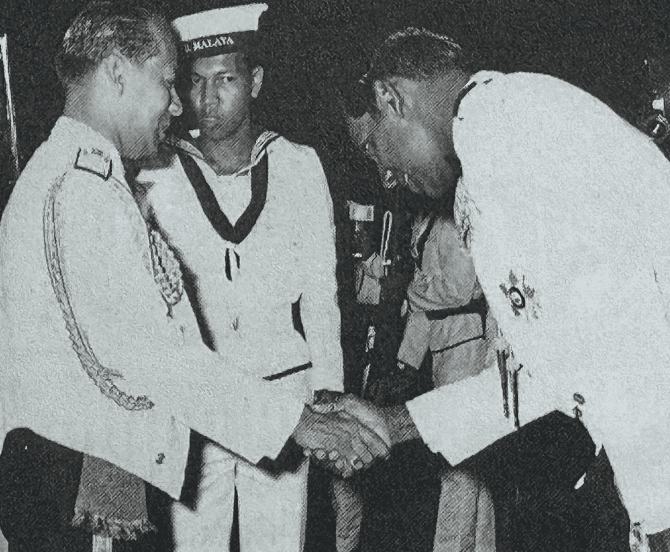
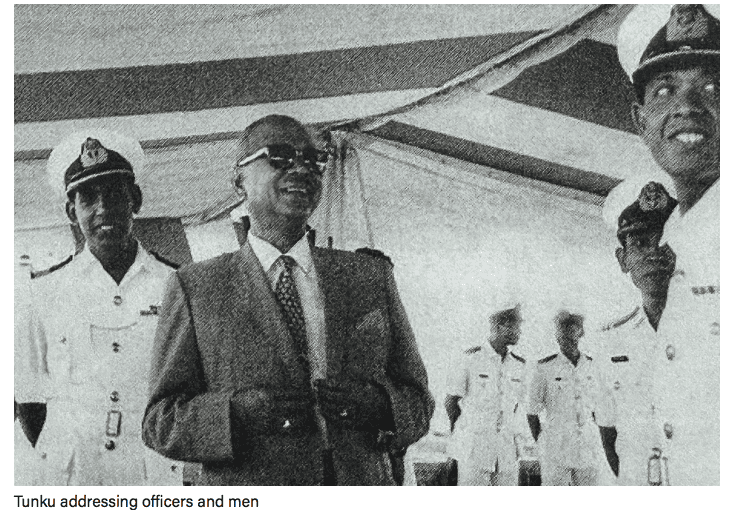
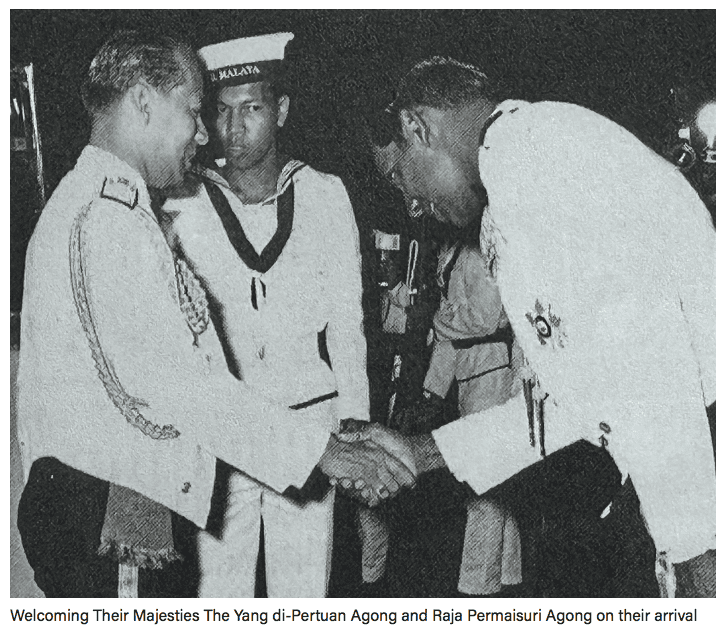
KD Hang Tuah received many visitors, including the Prime Minister, Tunku Abdul Rahman, Ministers and dignitaries. In September 1968, Their Majesties The Yang di Pertuan Agong, Tuanku Ismail Nasiruddin Shah and the Raja Permaisuri Agong boarded the KD Hang Tuah at Port Swettenham (Port Klang today) for an official visit by sea to the RMN Base at Woodlands, Singapore.
There were some interesting anecdotes worthy of mention. There was a disciplinary case where the Queen’s Regulations (QR) and the Admiral’s Instructions (AI) were not adhered to as “the outcome would have adversely affected their careers”. In another incident, a Royal Navy seconded officer was ordered to leave the dining table and had his dinner served in his cabin, on account of rudely “flinging the bowl” of sambal belachan to the end of the table. In another incident, a potential diplomatic embarrassment was avoided when an inexperienced diplomat was saved from a diving mishap while being a guest on board KD Hang Tuah.
Commander K. Thanabalasingam was given command of KD Hang Tuah on March 1 1967.
In addition to patrolling duties, KD Hang Tuah was also tasked with training Malaysia’s pioneering batch of commandos, comprising volunteers from the navy and the army. This unit was known as the Malaysian Special Service Unit (MSSU).
KD Hang Tuah was decommissioned on 30th May 1977, “concluding her service with an impressive career spanning 183,040.75 nautical miles”. Today KD Hang Tuah (F76) is berthed at the Royal Malaysian Navy jetty at Lumut – “and now preserved as a floating museum ship.” She retains her status as a Royal Ship (Kapal Diraja).
FIRST SHORE COMMAND
In October 1966, it was back to shore when Lieutenant Commander K. Thanabalasingam took up appointment as Commanding Officer (CO) of KD Sri Tawau and Resident Naval Officer (RNO) Tawau. He was accommodated at the 5 Brigade Officers’ Mess. Interestingly, the head of Signals at the base then was a Major Arthur Schubert, who on retirement as Lieutenant Colonel would later serve as the General Manager of the RSGC (1980-1984). The Head of the Engineer Corps was Major Ray Chen, who would retire as Brigadier General. Uncle Ray, as he is fondly remembered, was an active golfer at the RSGC. A group of friends, including his son Patrick Chen, his buddy, Chris Syer and yours truly, held a 9th Memorial golf game in his honour recently at the RSGC.
APRIL FOOL’S JOKE
Barely four months in command at Tawau, Thanabalasingam received a letter from the CNS, Commodore A.N. Dollard, dated Jan 31 1967 (received on February 3 1967), informing him of his promotion to Chief of Naval Staff in “November/ December 1967”. The day before, on February 2, there was an overlap of the two signals received informing him of his new appointments. There arose some confusion. Lieutenant Commander K Thanabalasingam thought it was an April Fool’s joke. He was then only a month short of his 31st birthday, ascending to become the CNS at the year’s end.
METEORIC RISE
“The subsequent promotions were meteoric”. From Lieutenant Commander in February to Commander, Captain, and Commander-in-Chief of the Naval Staff on December 1 1967. “I held four ranks within one year” – probably unprecedented in peacetime naval history, “and wondered if I could cope.”
CHALLENGES AND LEGACIES
“East of Suez”.
The young Commander-in-Chief of the Naval Staff had a rude wakeup call, only a month into his job. On January 16 1968, the British Prime Minister, Harold Wilson, made a formal announcement in the House of Commons of the Government’s withdrawal, “East of Suez” of all British military installations and troops. While this withdrawal was driven by a combination of political, economic and strategic factors in Britain, it came as a shock. There was no prior notice or consultation, notwithstanding the existence of the Anglo-Malayan Defence and Mutual Assistance Treaty (AMDA) signed on Oct 12 1957, by our first Prime Minister, Tunku Abdul Rahman Al Haj, with the British Government, shortly after Independence.
The Tunku was personally “annoyed” while considering it as “disrespectful” on the part of the British with this sudden announcement. The Singapore naval and military base was the largest Britain outpost in the Far East. Malaya (later Malaysia) had historically been dependent on the British and its Commonwealth partners, Australia and New Zealand, for its national security interests. This was a “defining moment” for Malaysia – the need for “selfreliance” for its national security and thrust upon the young nation without notice.
Thus began the process of modernisation and expansion, which would present the biggest challenge of the newly minted CNS. Conversely, the withdrawal was considered a “blessing in disguise” as “the consequent naval plans and developments were phenomenal and rapid”. The landscape of the nation’s security would change dramatically as the nation forged ahead on the road to “self-reliance”.
NAVAL PROCUREMENT POLICY
Since Independence, the four Chiefs to head the RMN comprised one from the British Royal Navy (Commodore E.D. Norman) and the subsequent three were from the Royal Australian Navy (Captain W.J. Dovers, Commodore A.M. Synnot, and Commodore A.N. Dollard). Commodore K. Thananabalasingam was the first Malaysian to assume the post of Chief of Naval Staff of the RMN.
In those years, the RMN depended solely on Britain for its ships, equipment, armament, personnel and training – in effect, everything that was required by the RMN. There was a policy shift away from dependence solely on Britain following the appointment of a Malaysian Chief of Naval Staff. This shift presented itself in the form of a directive from the Prime Minister, Tunku Abdul Rahman, to his Defence Minister, who was also Deputy Prime Minister, Tun Abdul Razak, to “equip RMN with missiles … as a deterrent for our national security”. This task fell into the lap of the CNS.
There were no such missiles readily available in the market at that point in time. The CNS was directed by Tun Razak to “scout the world, if necessary”. It was in early 1969, at the Greenwich International Defence Exhibition, that the CNS overheard a conversation about surface-tosurface missiles being developed by France for its Navy. The subsequent follow-ups with the French Ambassador in Kuala Lumpur, Monsieur Epinat, were to lead to the introduction of the “Exocet” missiles. The pursuit of the Exocet was “put on hold” by the unfortunate outbreak of the May 13 incident. Eventually, following a series of visits, prototypes, tests and due diligence, the Malaysian Government in early 1971 placed an order for four La Combattante patrol vessels (later referred to as Fast Strike Crafts- FSC) armed with Exocet missiles.
The official announcement by the Prime Minister, Tunku Abdul Rahman Al Haj, of “our intention” did not go well with the British, even if they had nothing close to the Exocet to offer. Attempts were made nonetheless to “dissuade us” from proceeding with the purchase. The Exocet purchase marked the beginning of the departure of armaments procurement from Britain.
THE OLD BOYS NETWORK
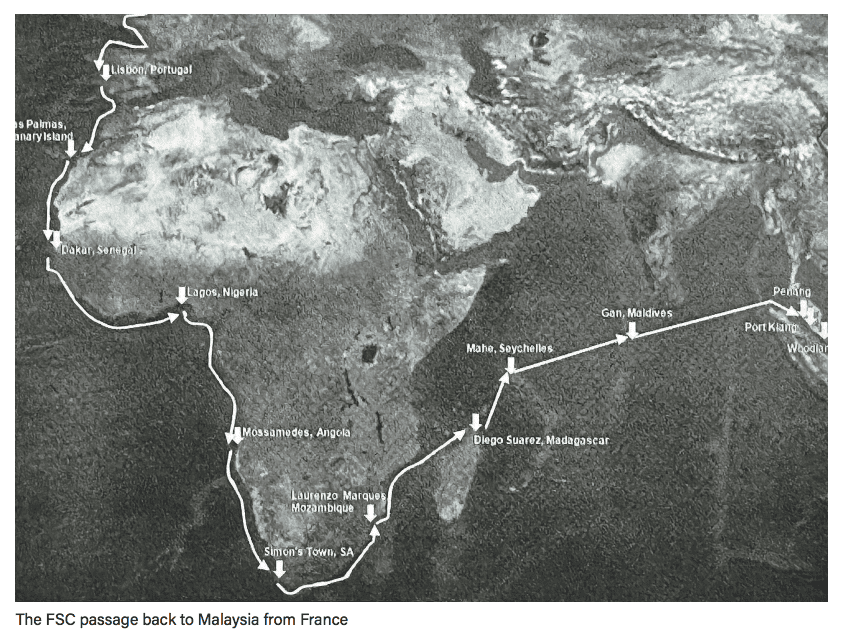
While awaiting the final delivery of the four La Combattante patrol vessels from the French Company, a new challenge on how to bring home the vessels loomed ahead. The Suez Canal has remained closed since the Egyptian-Israeli Six-Day War in 1967. The Egyptian Government was in no hurry to open the Canal then. This matter was further compounded as Malaysia had no diplomatic relations with South Africa due to its “apartheid” policy, which could enable the vessels to navigate through its coast without hindrance. Sailing across the Atlantic and entering the Pacific Ocean through the Panama Canal would be physically challenging and costly. Shipping it through on board some huge commercial vessels was also a distant possibility, but…
It would seem like the sea Gods were smiling on the young CNS. It was by chance that a coursemate from the HMS Vernon days in 1963, then the South African Naval Attache in London, was seeking to reestablish contact with our CNS through his counterpart, the Malaysian Naval Attache. Communication was then established. It was later confirmed that another coursemate at HMS Vernon, Rear Admiral Edward W.Jupp, was now the Flag Officer of the Southern Command – “who saw no problems in doing the necessary for our ships”. However, all the logistics agreed upon with SAN were “unofficial” – it was “strictly confidential on a Navy-to-Navy basis”. Any leaks arising, “my head (Razak) will roll and if mine goes, yours will follow”.
A team of officers and crew was assembled. The Squadron departed Cherbourgh, France, in the first week of May 1973 -retracing the route taken by KD Sri Kelantan and KD Sri Terengganu in 1963 through the rough seas of the Bay of Biscay. This time, however, it bypassed the Mediterranean, heading south through Morocco to Angola and finally reaching Simon’s Point, South Africa. The ships were refuelled, restocked with provisions and water. “The SAN displayed genuine friendship towards our officers and men”. The old boys’ network did wonders.
The squadron “finally arrived home at Woodlands Naval Base in Singapore on June 30 1973”.
PHOTO ACKNOWLEDGEMENT
All images in this article are reproduced with permission from “The Admiral’s Reflections” by Rear Admiral Tan Sri Dato’ Seri (Dr) K. Thanabalasingam (Retired).
ABOUT THE AUTHOR
Loong Wei Hin has been a proud member of The Royal Selangor Golf Club for nearly 40 years. He has served as a member of The Committee. Currently playing to a 14 handicap, he is known for giving the younger golfers a spirited run for their money. A keen writer and a history enthusiast, Loong brings to life the untold stories of Malaysia’s naval legacy from the Admiral’s Reflections.