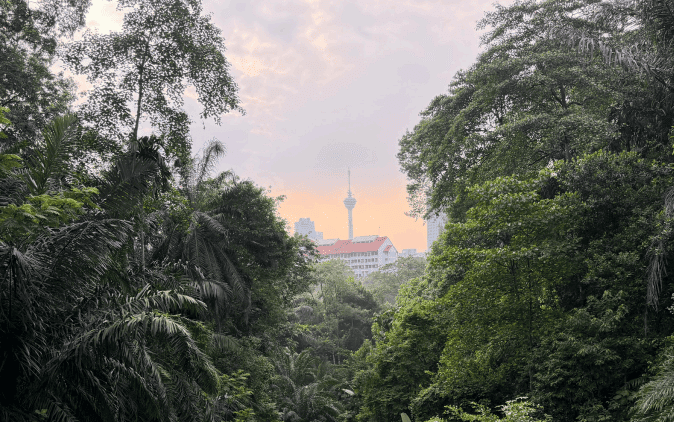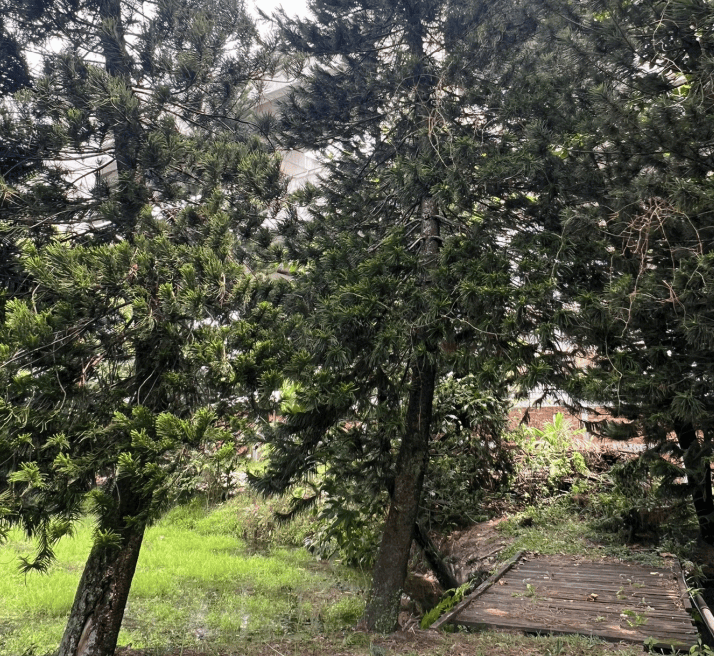
The Araucaria columnaris, commonly known as the Cook Pine or New Caledonian Pine, can be found at the Suleiman Course near the lake.
SCIENTIFIC CLASSIFICATION:
• Common names: Cook Pine, New Caledonian Pine
• Family: Araucariaceae
• Native range: New Caledonia, an island country in the southwest Pacific Ocean
• Type: Gymnosperm (conifer)
DESCRIPTION
Araucaria columnaris is a tall, evergreen conifer with a distinctive, narrow, conical crown. It typically grows between 50–70 metres tall (about 160–230 feet). The trunk is often slightly curved near the base before straightening upward. Its bark is rough, grey, and resinous, peeling off in thin, paper-like sheets.
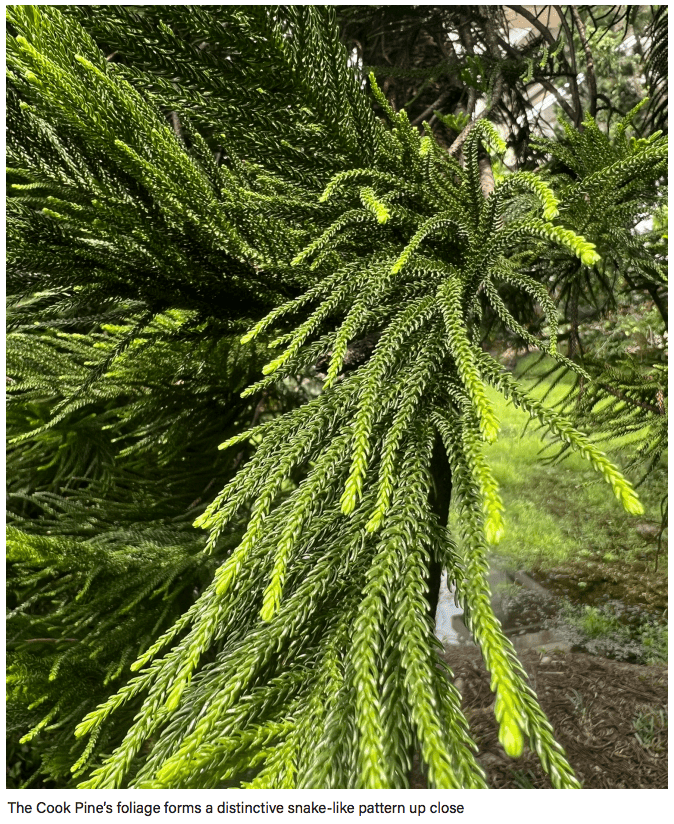
The branches grow in whorls around the trunk, and the branchlets are densely covered with small, green, needle-like leaves. These inward-curved, overlapping, spiralpatterned leaves give the foliage a unique, snake-like appearance when viewed up close.
REPRODUCTIVE STRUCTURES
• Female cones: Large, scaly, eggshaped, found on upper branches
• Male cones: Smaller, scaly, and foxtail-shaped, located at the tips of lower branches
GROWTH AND HABITAT
This species is widely planted as an ornamental tree in parks and large gardens across warm, temperate regions. It is commonly found in Australia, New Zealand, the Philippines, Mexico, and Hawaii. Cook Pines are wind-resistant, hardy, and relatively free from major insect or disease issues, although root rot may occur in poorly drained soil.
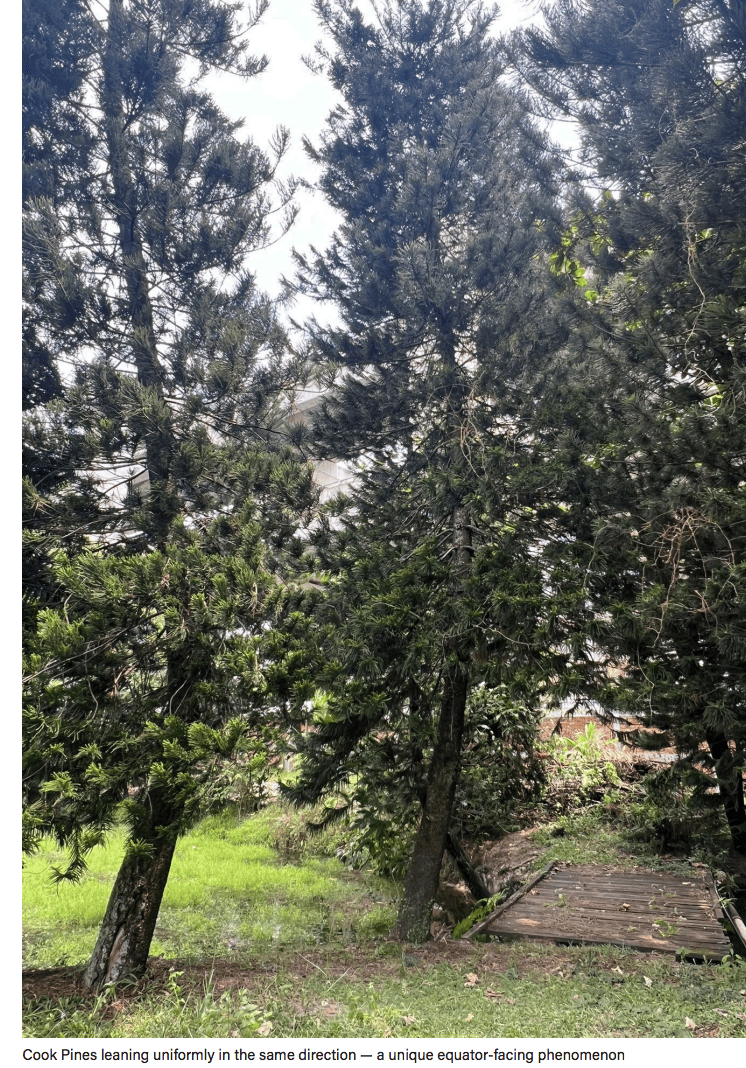
UNIQUE PHENOMENON – THE EQUATOR-LEANING MYSTERY
One of the most fascinating traits of Araucaria columnaris is its consistent lean toward the equator. Researchers at California Polytechnic State University studied 256 Cook Pines on five continents and discovered an extraordinary pattern:
• Trees in the Northern Hemisphere lean south,
• Trees in the Southern Hemisphere lean north, always tilting toward the equator.
The farther the tree grows from the equator, the greater the angle of the lean, with some leaning up to 40 degrees. Unlike most trees, which naturally correct themselves to grow upright, Cook Pines maintain their tilt throughout their lifespan.
This phenomenon can also be observed in the Cook Pines along the Suleiman Course, where the trees display the same directional lean, as seen in the accompanying photo.
The reason behind this mysterious behaviour remains unknown, making Araucaria columnaris not only an elegant and resilient conifer, but also one of the most intriguing trees in the world.