T he upcoming August Nature Walk, which will be held in Car Park A, will take a different approach to what we know and what we don’t know about the biomechanics of trees. The participants will be briefed about the importance of making risk assessments on the trees in order to ensure the safety of make passers-by. Recently, detailed tree risk assessment for each branch of the large Xyclocarpum tree in the lobby and the heritage Rain Tree have been completed. There have been periodic assessments to assess the progress of deterioration in trees and several mitigation measures also undertaken.

Since 2007, we have planned programmes to save trees of all sizes and ages within the club, with specific attention paid to high-risk areas such as the parking lot, main roads, clubhouse, club boundaries, and a few targeted trees on the golf course. There are 1518 trees in total included for the annual assessment comprising 33 trees in the parking lot, 383 trees lining the clubhouse boundaries, and 1102 possibly hazardous trees on the golf course itself.

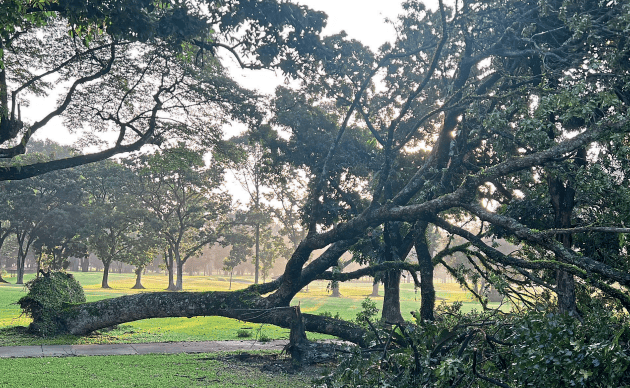
Tree failure is not unheard of in RSGC. It is defined as the physical breakage of the tree’s trunk, one or more branches, or one or more roots. There are three common factors contributing to a tree’s failure during severe weather; weak branch union, decayed wood and root problems.
As tree keepers in RSGC, we came up with a plan more than 10 years ago for the protection, inspection and maintenance of trees within the Club’s boundaries. First, a tree is evaluated using the Tree Risk Assessment Form from the ground. In most tree inspection procedures, the arborist is instructed to systematically view the tree from the top to bottom and move 360 degrees around it. The arborist will visually access the tree’s structure, describe defects, evaluate the likelihood of failure, and note what would be damaged if the tree failed. The components also involved are the site factors, tree structure, vigour and target value. Following this, further recommendations and mitigation actions like tree pruning, tree treatment, or propping would be implemented.
There is a standard form for visual tree assessment which has been qualified and certified by the International Society of Arboriculture (ISA). The form will be explained briefly during the walk.
Tools that are commonly used include soft-faced hammers or mallets that are designed to offer driving force without damaging the trunk surfaces. These tools also reduce the force transmitted back to the arm or hand of the user. Examining tree sound during tree inspection will also indicate when trees have been severely damage, as the resulting sound will vibrate differently if decay is present in the tree.
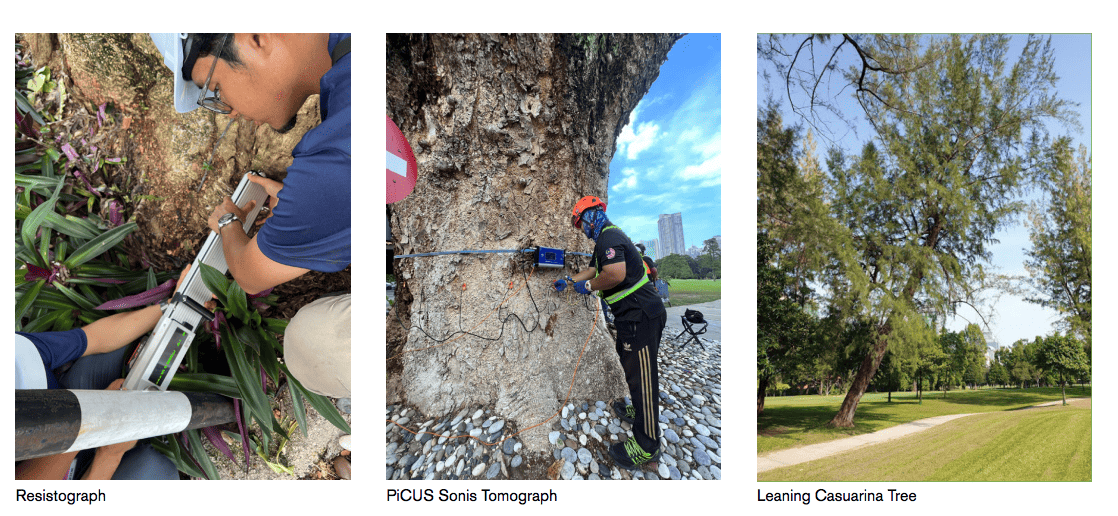
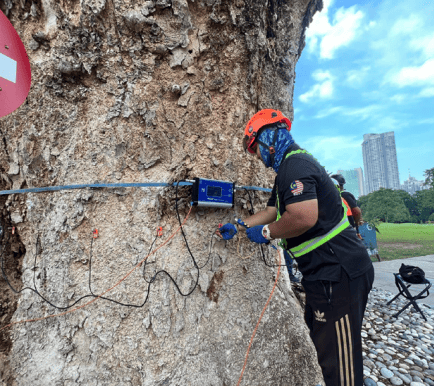
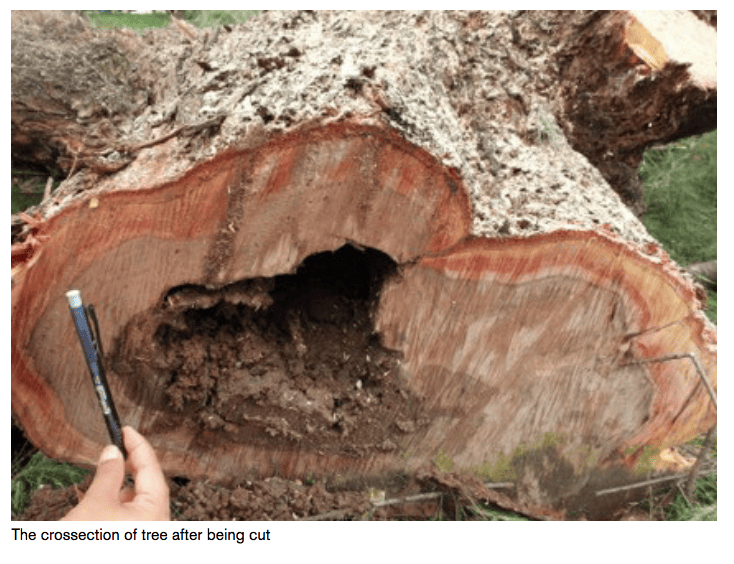
Internal testing equipment Sometimes visible evaluations are insufficient and in order to determine a tree’s danger of failure, we need to learn more about its internal condition. A number of internal defects detecting systems have been modified and tested for use in arboriculture. By measuring the speed of sound waves passing through the stem using several sensors attached to the trunk with tiny nails that are tapped to transmit signals past the branches, the PiCUS Sonic Tomograph is a noninvasive tool that can identify tree degradation. In February 2020, the leaning Casuarina tree at the 9th Hole Old Course was tested using acoustic tomography (PiCUS Sonic Tomograph). The results showed that there was a significant hole inside the trunk that was invisible from the outside. In addition, the tree had been leaning for an extended period of time. The decision to cut the tree in October 2020 revealed a large hole, which was used to affirm the test’s visual results.
However, in certain roots that cannot be accessed by the PiCUS Sonic Tomograph, another instrument known as the Resistograph will detect decay and cavities in trees and timber. Through this technology, arborists can directly determine the structural defects present in roots and upper branches. It is recommended that additional testing with a resistance microdrill be conducted accurately locate and evaluate the defects. No one piece of equipment is enough to provide a complete assessment.
To preserve the stability and health of the trees, biannual selective pruning is performed on the trees in the parking lot and annual pruning takes place around the Club boundaries. Monthly treatments are also run for trees that are diseases or at the risk. To preserve the firmness of the trees, yearly pruning takes place on the ones on the golf course that are located near the play area, rain shelters, buggy track, and tee box area. To ensure everyone’s safety on the ground and to support the large preserved tree’s canopy, tree propping is also advised.
It is our responsibility to protect both trees and nature while also maintaining the health and safety of people and the surrounding buildings.