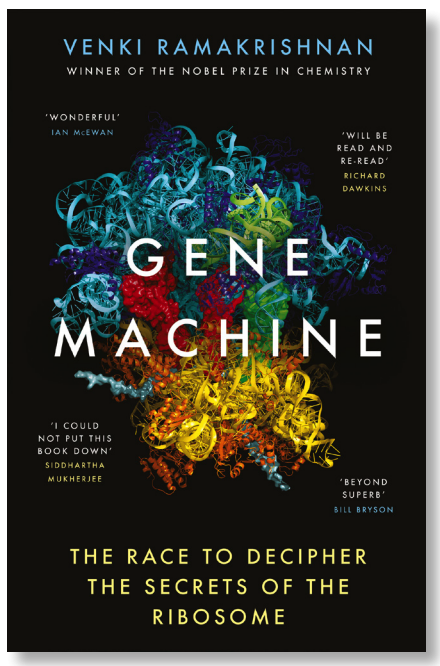
Reading Gene Machine by Venki Ramakrishnan was both enlightening and unexpectedly personal. Far more than a chronicle of scientific achievement, this memoir reveals the emotional and human side of a Nobel Prize-winning journey. While it revolves around the complexities of molecular biology and the ribosome, what stood out to me was how accessible and reflective the book felt—even for someone without a scientific background.
Ramakrishnan, who won the Nobel Prize in Chemistry in 2009, writes not only about the technical challenges of uncovering the ribosome’s structure but also about the personal and professional struggles he faced along the way. What I appreciated most was his openness. He didn’t follow the traditional path into biology; originally trained as a physicist, he transitioned into biology in his thirties, with minimal formal education in the field. He shares his struggles, setbacks, and triumphs with what he himself calls “disarming honesty,” offering insight into the “pitfalls, mistakes, tensions, and rivalries” that often define the world of academic science.
At the heart of the book is the scientific race to decode how the ribosome works. Ramakrishnan explains the use of X-ray crystallography to reveal its structure—a painstaking process that took years of collaboration and effort. I was surprised by how gripping these sections were. Despite my lack of scientific training, his use of clear language, analogies, and personal anecdotes made even complex ideas remarkably easy to follow.
One of the most striking aspects of the memoir is his candid exploration of the darker side of academic science. He doesn’t shy away from discussing the intense competitiveness, inflated egos, and politics that influence research and recognition. He describes a world where scientists often guard data, rush to publish first, and aren’t always generous with credit. It was eye-opening to see how the pursuit of knowledge can be shaped as much by ambition and rivalry as by curiosity and collaboration.
Perhaps the most unexpected part of the book is his reflection on winning the Nobel Prize. Rather than celebrating it as an unambiguous triumph, Ramakrishnan reflects on the complications it brought— ranging from the pressures of sudden fame to the disruption of ordinary life. He questions whether the Nobel system truly reflects how science works, noting that the prize often overlooks the essential contributions of collaborators, postdocs, and technicians.
The memoir also explores more personal terrain: his deep partnership with his wife Vera, the challenge of balancing family with an all-consuming career, and the emotional toll of scientific life. These moments of vulnerability add real depth to the narrative and serve as a reminder that behind every major discovery is a person facing the same everyday struggles as anyone else.
Another standout theme is Ramakrishnan’s advocacy for open science. He expresses concern about how difficult it is for the public to access and understand modern scientific research and makes a compelling case for greater transparency and better communication. I found his call for scientists to engage more meaningfully with the public both timely and important.
Gene Machine is not just a book about molecules or lab work. It is a story about persistence, reinvention, and navigating complex systems with integrity. It provides a rare behind-the-scenes glimpse into the emotional and political realities of life at the frontiers of science. I came away not only with a better understanding of the ribosome but with a renewed respect for the people who dedicate their lives to unlocking the secrets of nature.
In short, this is a thoughtful, well-written memoir that makes science feel deeply human. I would recommend Gene Machine not only to those interested in science, but to anyone who enjoys stories of resilience, curiosity, and the pursuit of something greater than oneself.