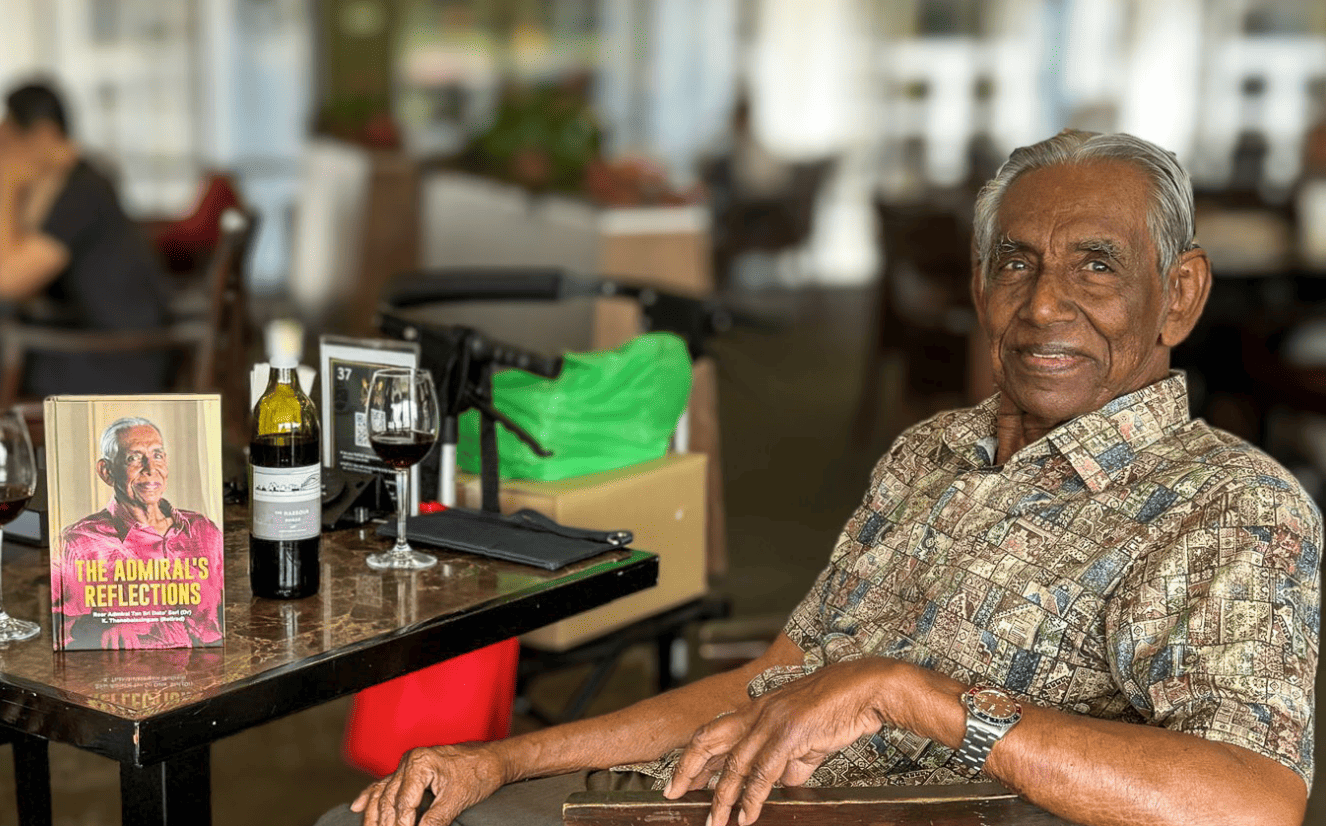
In 1955, a 19-year-old K. Thanabalasingam was captivated by an “insignificant” advertisement that read: “Join the Royal Malayan Navy and See the World.” This simple invitation set him on a storied and sterling career, ultimately leading him to become the first Lord of the Seas for Malaysia’s nascent maritime force.
Opting for the crisp white uniforms, countless disciplined drills, and the uncertainty of the ever-roiling seas—rather than the well-trodden middle-class paths of medicine, law, or engineering— Thanabalasingam spearheaded “the magnificent 9,” the inaugural cohort of Officer Cadets to join the Malayan Navy.
The recruitment process was “extremely prompt.” Young aspirants who had just taken or passed the Overseas Senior Cambridge School Leaving Certificate were swiftly issued “first class return rail warrants” for interviews, followed by medical tests, before being formally recruited for training at the Woodlands Naval Base in Singapore. Of this pioneering group, only three members of the maiden intake remain: Captain Cheah Leong Voon (an active fellow member of the RSGC), Babu Nettur (who resides in Melbourne), and K. Thanabalasingam.
AN UPSET FATHER
A few months after Thanabalasingam signed up, the Oversea Senior Cambridge School Leaving Certificate results were announced. He had scored a Division One – l’élite de l’élite.
Mr. A. Atkinson, the Headmaster of Victoria Institution, tried to convince Thanabalasingam’s father, Mr. S. Karalasingam, that the best path for his son was to continue studies at Form VI and then proceed to university. “Father could not disagree with the HM,” Thanabalasingam recounted, “and there began a tussle between us – the first and only disagreement. I stood my ground despite the love and respect for my father and favored the destiny which was awaiting me.
RITANNIA ROYAL NAVAL COLLEGE (BRNC), DARTMOUTH
After completing eight months of training with the Royal Malayan Navy at Woodlands, Singapore, the cadets departed for England in December 1955 to undergo training at the Britannia Royal Naval College (BRNC) in Dartmouth. Their passports, with blue covers, proudly stated these young cadets as British subjects.
Training at the BRNC was intensive, covering subjects from nuclear physics to mechanical and electrical engineering, alongside core naval disciplines. These included seamanship, navigation, gunnery, communication, Morse code, mines, anti-submarine warfare, midshipman duties, survival training, and naval customs, traditions, and etiquette. Flying instruction at the Royal Naval Air Station and submarine base was also included, though these courses were later discontinued for subsequent intakes, likely due to financial considerations. The largely technical nature of the training syllabus suggests that candidates chosen for naval cadet officer training must have achieved high grades in science and mathematics subjects in their Cambridge School Leaving Certificate.
GRADUATION
On May 1st, 1958, three members of the intake—K. Karalasingam (Thanabalasingam’s official registered name at BRNC), Cheah Voon Leong, and Khoo Tee Chuan— successfully graduated from the BRNC and were commissioned as Acting Sub Lieutenants by the Admiralty. The trio were assigned to different navy ships for their sea service. “The remaining six of my cohort completed BRNC at different stages,” he noted. The rigorous BRNC training spanned a total of twentyeight months, which, combined with the eight months at Woodlands Naval Base, Singapore, brought the total training period to thirty-six months.
Acting Sub Lieutenant T. Karalasingam reported for duty at HMS Chichester in Glasgow, Scotland, on May 7th, 1958.
Anglo Malayan Defence and Mutual Assistance Treaty Signed on October 12, 1957.
Malaya gained independence on August 31st, 1957, with YTM Tunku Abdul Rahman Putra Al Haj as Prime Minister and Abdul Razak bin Hussein (later Tun) as Deputy Prime Minister and Defence Minister. The Tunku, keenly aware of the new nation’s limited (or non-existent) defense capability, quickly signed a bilateral defense agreement, the Anglo Malayan Defence and Mutual Assistance Treaty, with Britain on October 12th, 1957.This was viewed as “a post-colonial security arrangement that balanced Malaya’s new independence with Britain’s ongoing strategic interest in the region.” During this period, the heads of the armed services were largely officers from Britain, Australia, and New Zealand.
The Malayanisation of the armed services had begun a month earlier with the transfer of the British Royal Malayan Navy to the Royal Malayan Navy on July 1st, 1958, with its naval base remaining at Woodlands, Singapore.
COMING HOME
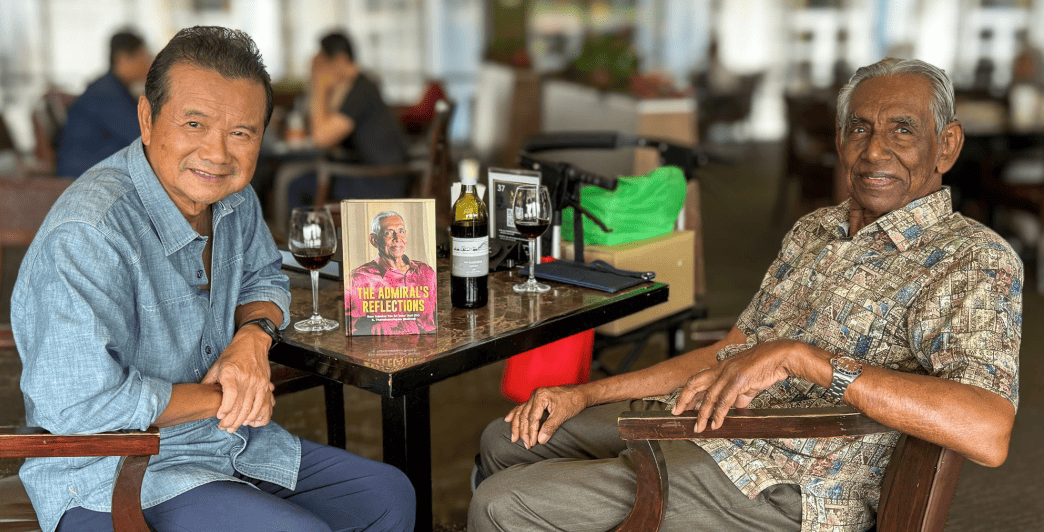
While at sea on HMS Chichester, Thanabalasingam received a letter from Principal Assistant Secretary (Cabinet), Abdul Kadir bin Shamsuddin (later Tan Sri), inviting him to transfer from the British Royal Navy to the Royal Malayan Navy. “I have always wanted to return and serve my country, and this came as a wonderful opportunity,” he reminisced over a glass of Shiraz in the Main Lounge. He accepted the offer but remained on board HMS Chichester to “gain sea experience.
Upon his return to Malaya in late 1958, he reported for duty at the RMN Base at Woodlands. His first assignment, beginning in January 1959, was at the Federation Military College (FMC) in Port Dickson as its first Naval Cadet Training Officer (Instructor). He recalled that it was likely in early 1960 that he first met YTM Tunku Abdul Rahman Putra Al Haj, who was in the area and decided to visit the college. Later that year, he was called back to sea by the new Chief of the Naval Staff, Captain W.J. Dovers, the first Australian to hold the post.
At the Woodlands Naval Base, he was appointed as the Gunnery Officer of HMMS (His Majesty’s Malayan Ship) Mahamiru, a coastal minesweeper. A few months later, he was promoted to Lieutenant and appointed as the Navigating Officer of HMMS Mahamiru. It was around this time that the RMN changed the prefix for all its ships to “KD,” Kapal Diraja (Royal Ship), thus KD Mahamiru came into being
This posting back to sea marked the beginning of a journey commanding ships and undergoing specialized training in torpedo and submarine warfare (TAS), including the Royal Naval Ship Diving Course in the UK. A notable highlight was taking command of KD Sri Kelantan at Portsmouth and, on December 16th, 1963, sailing with its sister ship, KD Sri Terengganu, to reach the Royal Malayan Naval Base at Woodlands by the end of February 1964. In those years, sailing was without today’s sophisticated Global Positioning (GPS) instruments. “We were out of sight of land,” he explained, “we had to ‘shoot’ (measure the angles to the horizon) planets and stars using sextants to calculate our position in the ocean.” The training at Woodlands and BRNC had certainly paid off!