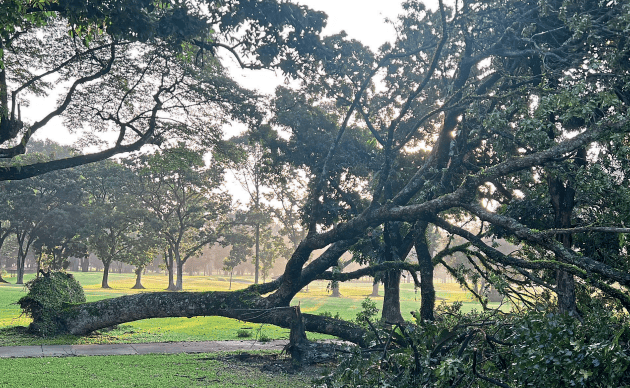
The form of a tree serves as a living record of the challenges it has faced and the resilience it has demonstrated through self-repair. The Elephant Ear tree (Enterolobium cyclocarpum), in particular, stands as a symbol of natural adaptation and the consequences of human action or inaction. Under structural stress, this species exhibits a remarkable capacity for response—developing adaptive growth, such as reaction wood in mechanically weak areas. Consequently, the Elephant Ear tree is often regarded as a master of self-healing.
Unlike animals, which can flee or shield themselves from injury, trees are rooted in place and must endure. Survival thus depends on their ability to “heal by faith,” relying entirely on internal physiological responses to external stressors.
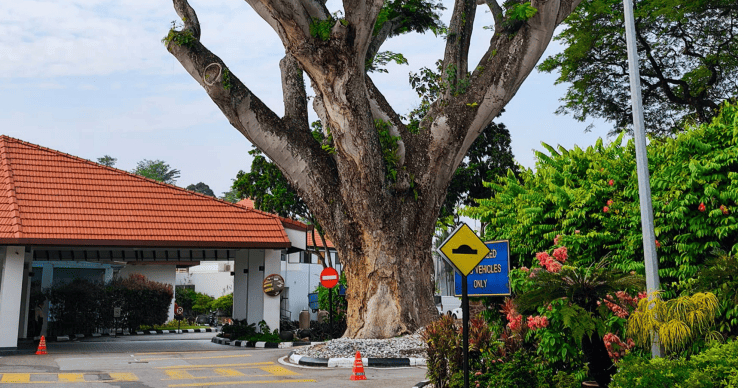
This particular Elephant Ear tree was in poor health, characterized by a sparse canopy and limited branching. It stands at 17.5 meters tall with a broad crown spread of 37.9 meters. Previously, crown reduction had been performed to reduce biomechanical load, especially on branches growing toward a nearby building. However, this intervention left the crown imbalanced. Generally, crown reduction in mature or veteran trees like Enterolobium cyclocarpum should not exceed 25% of the overall canopy volume in a single session. Follow-up pruning should be conducted after a minimum interval of twelve months, during which the new leaf growth on pruned branches must be monitored as an indicator of the tree’s response and ability to regenerate energyproducing foliage.
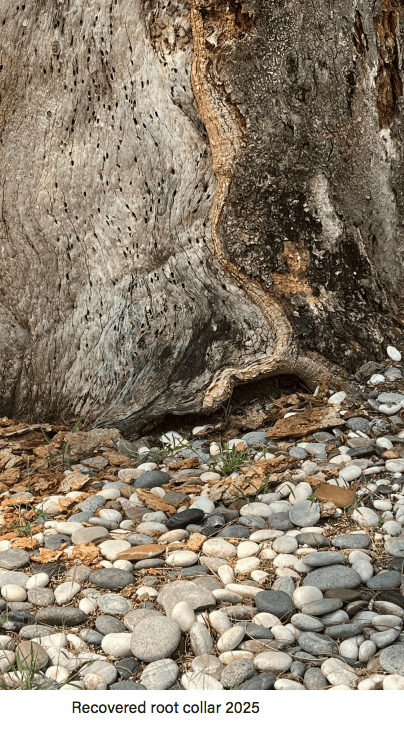
Signs of decline were evident in branch attachment points and parts of the canopy, including localized dieback and parasitic epiphytes. An inspection from the previous year had already revealed trunk deterioration, with a canker observed at a codominant branch junction. Despite this, the tree persists within a restricted root zone, although root decay and the presence of fungal fruiting bodies indicate ongoing active rot.
Recent assessments and mitigation efforts have noted degradation at several branch attachments. Following heavy pruning, one side of the tree— supporting more weight—was left structurally unbalanced. It has been recommended to monitor these affected areas over at least twelve months. Soil and canker treatments, including Mancozeb fungicide and Trichoderma spp. inoculation, have been implemented to improve soil health and resist pathogen activity.
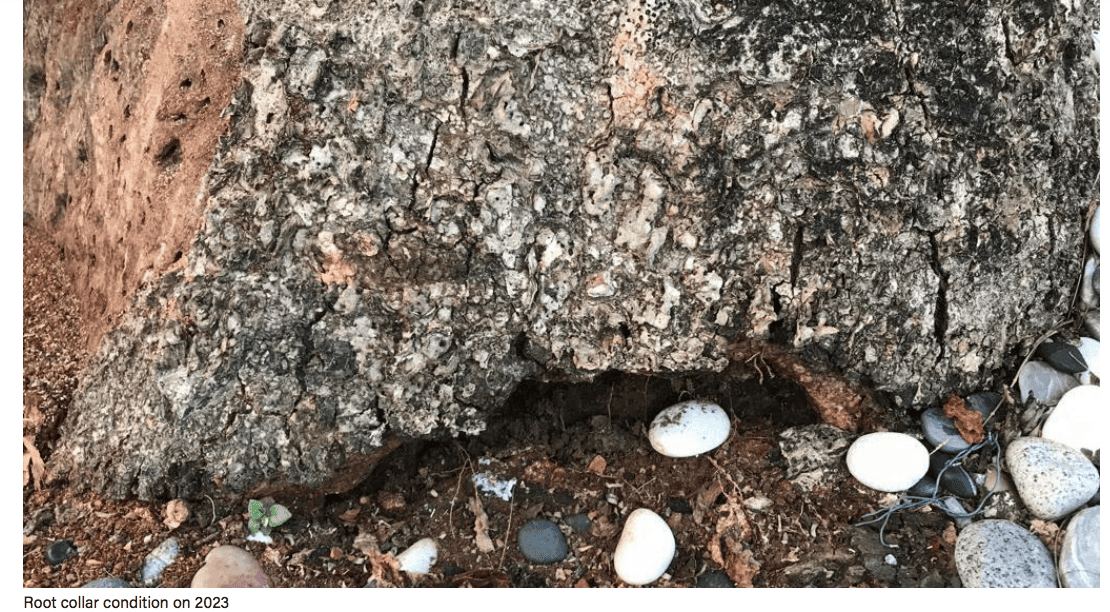
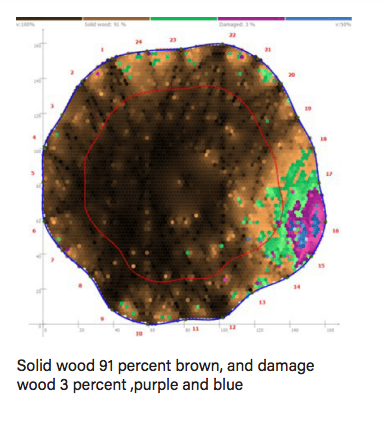
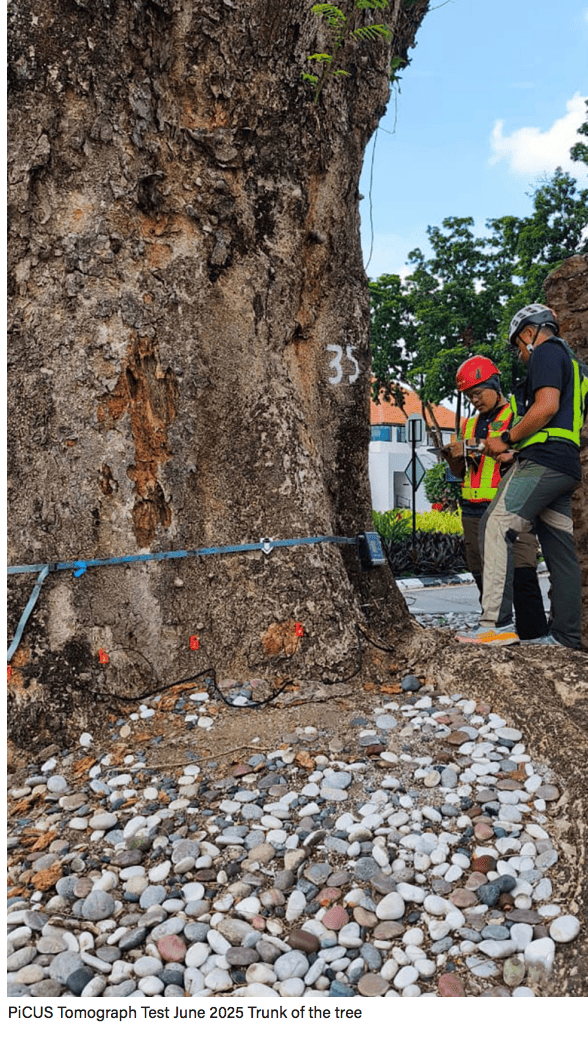
Concerns about the tree’s overall structural stability persist due to degradation at the root collar. Sonic tomography analysis indicates that the deterioration is in its early stages: 91% of the trunk’s cross-section remains sound, while 3% shows compromise. Although visual signs of external decay are present at multiple locations, internal scans as of June 2024 reveal only minor decay, particularly between measuring points 14 and 17. The emergence of new external rot symptoms and the tree’s declining vitality suggest that internal deterioration may be progressing.