“History is not only to be remembered, but to guide us. The seas may change, but the call of duty remains.”
THE LUMUT NAVAL BASE
The subject of relocation of the Naval Base at Woodlands, Singapore, was mooted as early as 1961 by Captain W. J. Dovers, the Naval Chief at that time. This plan received approval from Tunku Abdul Rahman, the Prime Minister, but was “aborted” when Singapore joined the Federation of Malaysia in 1963. However, following the separation of Singapore from Malaysia in 1965, the relocation issue was revived. Britain’s withdrawal “East of Suez” in early 1968 further accelerated the urgency for the relocation of the Naval Base at home for strategic and security considerations.
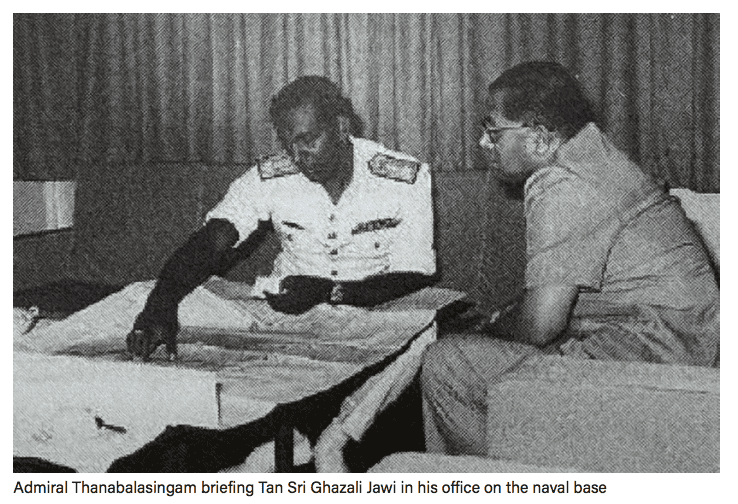
“In 1970, I decided to impress upon Tun Razak the urgent necessity to move out of Singapore”. Tun Razak was then the Prime Minister, and soon gave his approval to proceed with the relocation project. Thus began the planning process, involving inter alia, feasibility studies, financing, appointing project consultants and contractors, and the formation of an inter-ministerial “Steering Committee” and “Naval Base Project Team”
“I apprised Tun Razak that Lumut appeared the best choice … but a thorough evaluation was required to determine its feasibility”. German expertise was sought based on their record of post-war reconstruction efforts and naval capabilities. The parcels of land at Lumut were identified and land acquisitions secured through the Perak State Government, headed by the Menteri Besar, Tan Sri Ghazali Jawi.
The land clearance works began in 1972. The formal groundbreaking ceremony was held in 1974. The Lumut Naval Base was officially completed and operational in 1984. It is worth noting that no middlemen orc agents were involved in the purchase of the Exocets and the construction of the Lumut Naval Base. It stands proudly today as a symbol of national sovereignty.
Sadly, Tun Razak did not live to see its final completion due to his untimely death on January 14, 1976.
Commodore K. Thanabalasingam retired on January 1, 1977.
Today, Lumut, declared as “Naval Town” by His Royal Highness Sultan Azlan Shah in 2009, has been transformed from a quiet fishing village into a thriving township and service centre for navy personnel and supporting industries. The Naval Base continues to serve as a catalyst for its transformation.

MAY 13, 1969
On the evening of May 13 1969, the Admiral was hosting a dinner for the Thai Commander-in-Chief of the Royal Thai Navy, Admiral Sangad, who was at the tail end of an official visit to the RMN Naval Base at Woodlands, in the Wardroom of KD Malaya. In the midst of the CNS speech at dinner, he was annoyed when advised of a call from Mindef. A senior officer was assigned to take the call – but was back, “quick as a flash”. “I walked out and took the call”. General Tunku Osman Jewa, the Chief of the Armed Forces Staff, was “on the other end of the line”. The CNS was informed of the bloody riots that had broken up earlier in the day, and Razak had directed him to be back in Kuala Lumpur immediately. “I arrived at the RMAF Sungai Besi airport around 0615 on the morning of May 14, 1969.
Tunku Abdul Rahman Putra Al Haj took to the air and addressed the nation. Curfew was imposed in Kuala Lumpur and parts of Selangor, and later in parts of Ipoh and Penang.
Tun Razak set up the National Operations Council (NOC) with himself as Director of Operations on May 16, 1969. One of the main legacies of the tragic May 13 incident was the formulation of the New Economic Policy (NEP), set up with the noble objectives of eradicating poverty and the restructuring of the economy to increase the economic stake of Bumiputras to 30.0%. The NEP was meant for a period of 20 years, to end in 1991. Today, after 56 years of its existence, the NEP continues!
Tunku Abdul Rahman was “devastated by the riots”. He resigned as the First Prime Minister on September 22, 1970.
“I blame this episode solely and squarely on our politicians and politics,” lamented Commodore K.Thanabalasingam.

THE NAVAL ACADEMY
A study initiated by the Admiral in 1970 on the manpower needs indicated that some 220 officers would be needed for the period 1970 to 1973 to fill up existing vacancies as well as replacements for departing Commonwealth officers as part of the Malaysianisation process. The British Royal Naval College could not accommodate the places we were seeking, and neither could India nor Australia. Canada and the United States were willing, but their costs were prohibitive. That left us with no alternative but to train the staff ourselves. Tun Razak gave his approval.
The abandoned Khatib Camp at Sembawang, Singapore, was identified as the training establishment. A project team comprising staff from the Naval Staff Division (MINDEF), the Logistics Division of KD Malaya and KD Malaya Administration was set up to conduct the proper “assessment.” From its recommendations, planning started and renovation work commenced in November 1970. Commander Khoo Tee Chuan from the original intake was appointed as the Project Officer. By the end of January 1971, the RMN formally took over the Khatib camp as the Navy’s Cadets and Recruit Training Establishment (CARTE), with Commander Khoo Tee Chuan as the Commanding Officer. From 1st February, CARTE became an independent command under the Officer-in-Charge West Malaysia (NOIC-WM). CARTE was renamed KD Pelandok on July 1, 1971 – on the same day, 82 new recruits were commissioned. KD Pelandok and KD Malaya were later amalgamated in August 1972 to train officers, cadets, recruits and ratings.
Today, the Royal Malaysian Naval Academy, based in Lumut, remains fully operational and continues its central role in training naval personnel.
12 NAUTICAL MILES
The Admiral issued a “Letter of Promulgation on July 16, 1968 “clearly indicating the outer limits of Malaysian Territorial Waters (MTW) and foreign claimed waters around Peninsular Malaysia”. On August 7, 1969, Malaysia officially extended its MTW to 12 nautical miles under the Malaysia”s Emergency (Essential Powers) Ordinance no.7. “I am happy that I played a small but significant part in extending MTW to 12 nm in collaboration with two key personalities, Tun Razak and Tan Sri Ghazali Shafie.”
NAVY DAY DINNER AT PARLIAMENT HOUSE
The RMN Navy Day was held on the 1st of July because that was the day the Malayan Government operationally acquired the British Royal Malayan Navy from Britain in 1958. On July 1, 1971, His Majesty, YDPA Sultan Abdul Halim, attended the Navy Day Dinner at the Woodlands Naval Base, Singapore.
The following year, on July 1, 1972, His Majesty attended the Navy Day dinner at the same venue. It was in early October 1972 when His Majesty informed the Admiral that he would not attend any more Navy Day dinners, “unless we held it on Malaysian soil.”
Tun Razak was soon briefed – and the Admiral boldly enquired if the Parliament House could be used as the venue. Tun Razak, in a shocked reaction, exclaimed, “What? Parliament House!”
Twelve days later, the Admiral was informed by Tun Razak that the Cabinet had approved the request on “condition that the Navy foots all the bills.” Hence, from 1974 onwards, all Navy Day Dinners were held in the Parliament House – “until my retirement.” History was made.
SERVING THREE AGONGS AND THREE PRIME MINISTERS
“I was truly honoured to have served three Yang di-Pertuan Agongs during my tenure as the Chief of the Naval Staff.” The three YDPAs were Sultan Ismail Nasiruddin Shah Ibni Almarhum Sultan Zainal Abidin, Sultan Abdul Halim Mu’adzam Shah Ibni Almarhum Sultan Badlishah, and Sultan Yahya Petra Ibni Almarhum Sultan Ibrahim.
The three Prime Ministers were Tunku Abdul Rahman Putera Al Haj, Tun Abdul Razak Hussein and Tun Hussein Onn. Tun Razak also served as the Defence Minister from 1959 to 1970.

TUNKU ABDUL RAHMAN
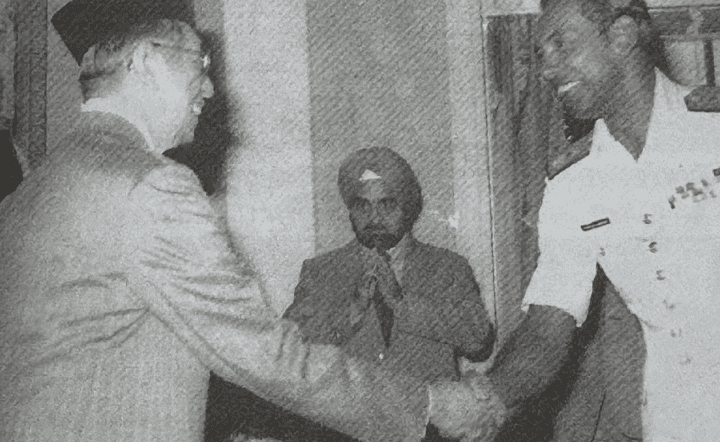
The Admiral was a frequent guest at the Tunku’s residence. The founding father of the Nation and fondly referred to as “Bapa Kemerdekaan” and “Bapa Malaysia” was happy to introduce me to his distinguished guests, and “I could tell he liked my company.” I was greatly “honoured” with the Tunku’s gracious gesture.
The Admiral is also a great admirer of the Tunku. He saw Tunku as “astute, had wisdom, foresight and intuition” and was the “right person to lead Malaya from the time of Independence.
The Tunku resigned as Prime Minister on September 22, 1970. “Personally, I feel sad that he was forced to resign.” The rest is history.
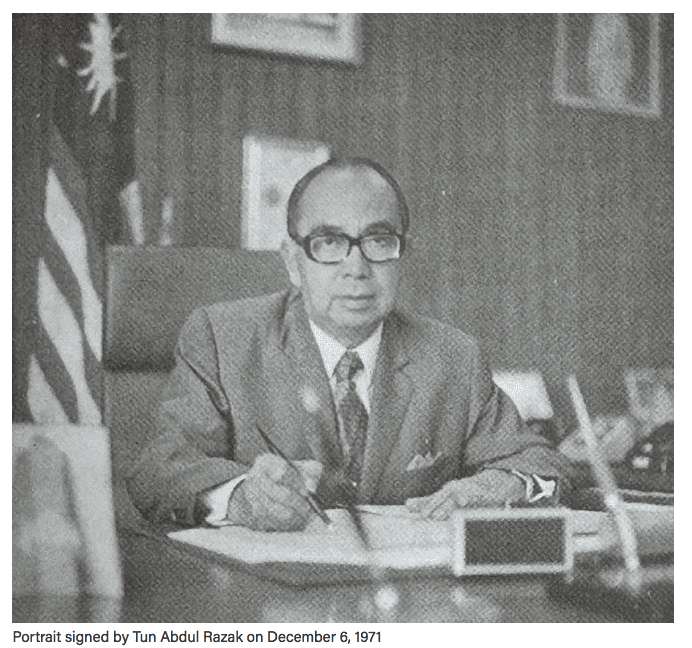
TUN ABDUL RAZAK
The Admiral’s relationship with Tun Razak began in mid-1968 when the DPM cum Defence Minister invited him over to his residence in the evening for “a nightcap and a chat.” These chats would develop into frequent events subsequently. “Tun Razak and I had become good friends, despite a 14-year age gap.”
Amid this calm and informal setting, the chats would dwell on topics beyond the armed forces to include politics, government and “even individuals.” I was indeed “greatly honoured and privileged.”
“He knew he could trust me,” and “I never betrayed that trust.”
This “close bond” enabled official matters to be resolved expeditiously, allowing the naval operations to run efficiently. This relationship did not go unnoticed among friends and associates, when the Admiral was referred to as the “blue-eyed boy” of Razak.
Conversely, it also attracted envy from within, which would test the relationship on many occasions. One notable event was when Tun Razak, as Defence Minister, agreed to reverse an earlier decision of the Selection Board under the Chief of the Armed Forces Staff Operational Council (CAPSOC) over the appointment of a Commanding Officer for a ship, upon hearing the appeal presented by the Admiral. The Officer originally recommended by the Navy was duly appointed. The storm passed, but the undercurrents lay in the shadows, unseen but ever present.
The Admiral served under Tun Razak, as Defence Minister from late 1967 (but for a brief break in 1973/1974) until his untimely death on January 14, 1976.
HUSSEIN ONN
Tun Hussein succeeded Tun Razak as Prime Minister on January 15, 1976. He also held the Defence Minister’s portfolio. “A plain and straightforward person with a high degree of integrity” – observed the Admiral.
CHANGING TIMES
It all began after 1971, when the Admiral began to notice that the Navy’s proposals for “promotions and appointments began to be challenged” by the Chief of the Armed Forces Staff Operational Council (CAFSOC). Then the recruitment of the Armed Forces was undertaken by the Personnel Department of MINDEF, and the “unwritten recruitment policy instituted after the May 13 Incident, which saw the intake of non-Malays into the Armed Forces whittled down.” The Navy had “very little say.”
RESIGNATION
The Admiral submitted his resignation to the Defence Minister Tan Sri Hamzah Abu Samah in 1974. Tun Razak, the Prime Minister, rejected his resignation. In September 1974, Tun Razak resumed the post of Defence Minister.
RETIREMENT
The Admiral retired on January 1, 1977, bringing to a close 22 years of loyal service in the RMN.
The Admiral’s Reflections is not just a memoir – it is a living document of Malaysia’s maritime journey, told by the man who helped shape it. As you read, ask yourself: What would I have done in the Admiral’s place? And what lessons still resonate in today’s Malaysia? Find out more …
PHOTO ACKNOWLEDGEMENT
All images in this article are reproduced with permission from The Admiral’s Reflections by Rear Admiral Tan Sri Dato’ Seri (Dr) K. Thanabalasingam (Retired).
ABOUT THE AUTHOR
Loong Wei Hin has been a proud member of The Royal Selangor Golf Club for nearly 40 years. He has served as a member of The Committee. Currently playing to a 14 handicap, he is known for giving the younger golfers a spirited run for their money. A keen writer and a history enthusiast, Loong brings to life the untold stories of Malaysia’s naval legacy from The Admiral’s Reflections .