Tee off in the 11th century and finish your game in the 21st century
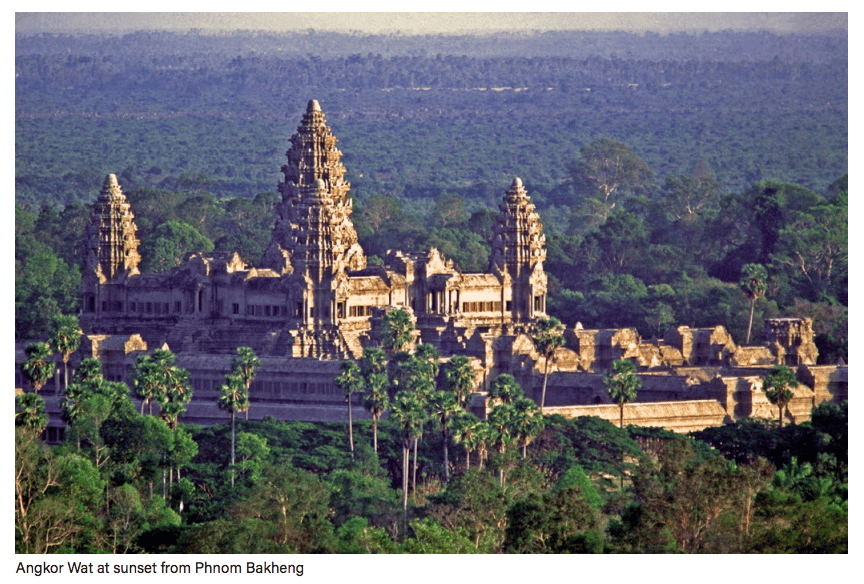
Siem Reap, just a two-hour direct flight from Kuala Lumpur on AirAsia, is the closest town to Angkor, the shining jewel in Cambodia’s tourism crown. What is recognized as the world’s largest religious site was once the epicentre of one of the region’s most influential empires.

Visitors soon discover there is much more to Angkor than the main temple of Angkor Wat, as there are hundreds of smaller religious sites scattered over a vast area of the plains of central Cambodia.
The earliest temples date back to the late ninth century, with the last one being completed in the 12th century. At that time, Angkor and Khmer culture held significant influence in Southeast Asia; however, Angkor later declined for reasons that continue to be discussed by archaeologists. The forest grew back and covered many of the temples for centuries. Despite ongoing visits by the Khmer people, the temples were ‘rediscovered’ by the French in the 19th century and are now considered some of the world’s most significant archaeological sites. The United Nations Education, Scientific and Cultural Organization (UNESCO) recognizes Angkor as a World Heritage Site, preserved for all people.
There are several golf courses near the temples, with Phokeethra Country Club providing sporting temple-goers the opportunity to play a round of golf on an historical expanse of land.

PAR FOR THE COURSE
The Phokeethra Country Club, managed by the Angkor Golf Resort, is just a 25-minute drive from the centre of Siem Reap. The 7,145-m-long, paspalum-grassed course, sculpted by a Bangkok-based designer, provides an invigorating and stimulating golfing experience.
This par-72, 18-hole course near Pock Village extends over 155 hectares of former rice fields and includes a clubhouse, locker rooms, and a terrace restaurant. Few courses in the world can claim ancient ruins as golfing obstacles. Archaeologists unearthed an 11thcentury laterite stone bridge here during the construction of the golf course. The bridge was once located on an ancient road linking Cambodia to Pimai in present-day Thailand, and it’s now possible to drive down it with a club rather than an oxen cart as the ancient Khmers would have done.

Lily-lined streams and ponds are common around the scenic course, and the par-three, 14th hole is the most visually striking of all. Ambitious or daring golfers can aim to drive over the water onto the green in one shot, but pinpoint accuracy is of the essence. Most golfers will play this hole safely and aim well left just to make par or even a birdie. The signature 18th hole features a pin well protected by bunkers on the front and left.
There are numerous expansive bunkers on the course, and many holes are well-guarded by them. Local knowledge is beneficial, and the helpful caddies here offer the best advice and a shade umbrella as and when necessary.
EMBRACING THE STONES
Dedicated temple-goers can spend a week exploring Angkor, but others can visit the main temples in one or two days. There are organized tours of the temples, although it is easy to do your own thing or hire a guide/ driver to visit the temples.
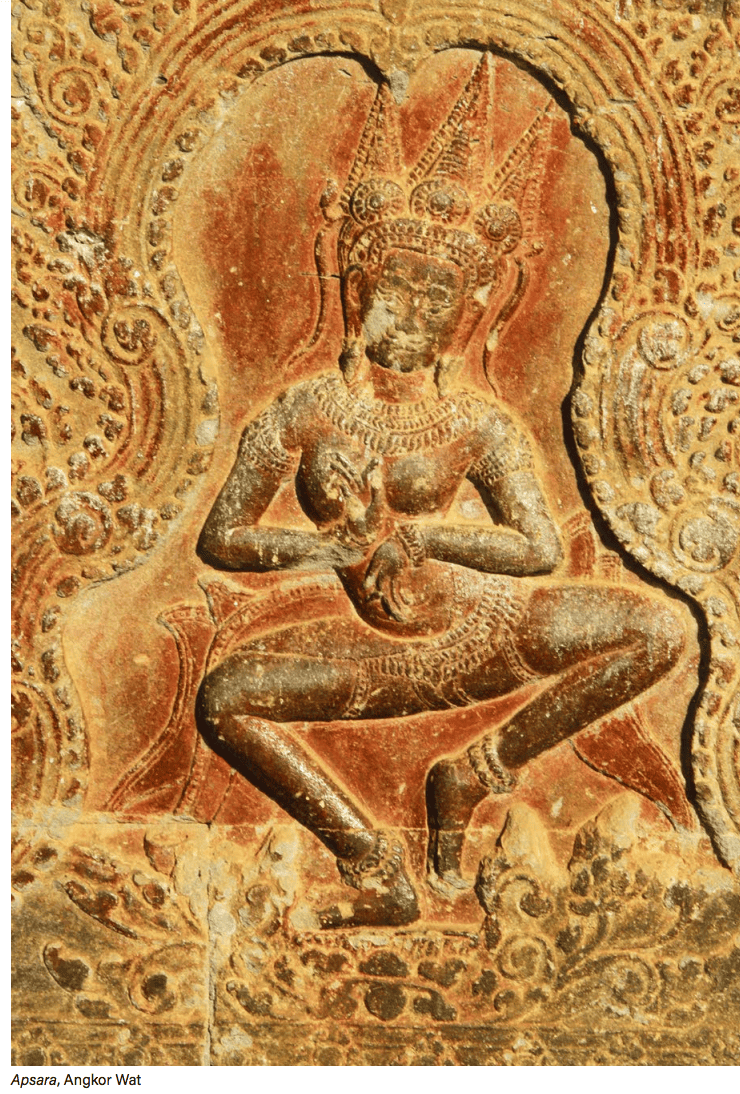
The highlights of most temples are the bas-reliefs or engravings on the sandstone walls. These intricate engravings feature those of celestial dancers, or apsaras. The apsaras line most temple walls, but none are as spectacular as those in Angkor Wat itself. Very few are the same, so there are thousands of dancers to be seen throughout the temples.
Ta Prohm Temple has been preserved with entwining roots of huge trees enveloping the stonework. This temple was intentionally left by archaeologists to enable visitors to admire how Angkor looked in the 19th century when it was first seen by Western archaeologists. This is also the temple that fascinated Angelina Jolie in the movie Lara Croft: Tomb Raider.

A NIGHT ON THE TOWN
Siem Reap is now a tourist town that attracts global adventurers, especially young travellers seeking to engage with the local culture and to enjoy the party atmosphere. Many international hotel chains have established themselves in the town, and there are countless bars to enjoy. Most visitors head to Pub Street, located in the town centre near the old market.
Some personal bar favourites are The Glide Bar (The Aviary Hotel), Red Piano (Pub Street), and the Foreign Correspondence Club, which offers a great open bar and restaurant and accommodation in the adjoining Avani property.

CURATED EXPERIENCES AT RAFFLES
While the beverages are cheap enough in these bars, those seeking a more elegant evening should head to the Elephant Bar in the Raffles Grand Hotel d’Angkor. The bar and indeed the hotel have been the venues of choice since 1932, when they opened to welcome adventurous explorers on their journey of discovery through the Far East. Since then, it has welcomed the rich and famous, writers and authors.
Raffles is among the finest hotels in which to stay, as it is opulently furnished, and its services and facilities make it one of the region’s grandest heritage properties. All 119 rooms and suites are elegantly fitted out with period furnishings, including some original detailing.
One of my favourite encounters in Raffles was an experience especially curated by the hotel’s dedicated gin butler. This hour-long activity included sampling several gins and concluded with a generous gin and tonic. The gin and tonic served was made using the hotel’s Elephant Bar Dry Gin, one of 30 or so in the hotel’s gin-ventory. The Elephant Bar, located next to the lobby, provides a memorable experience in heritage surroundings.

The hotel serves Cambodian dishes along with international favourites, and its Champagne breakfasts, served in Café d’Angkor, are legendary. Charles Mignon Premium Réserve Brut Champagne is poured during breakfasts that combine buffet and à la carte options.
The hotel’s 1932 Khmer Cuisine Restaurant enables guests to enjoy specially curated menus featuring classic Khmer dishes. Several set menus from the hotel’s illustrious past are offered. It was a big decision choosing between the menus, but we opted for the ‘1960s – The Golden Age’ menu. Cambodia underwent considerable development from 1955 to 1965 under King Sihanouk. In 1967, the former US First Lady, Jacqueline Kennedy, visited to add her seal of approval to the country’s advancements.
The chosen menu included popular Cambodian dishes that showcased local ingredients like Kampot pepper, Banteay Srey vanilla, palm sugar, and banana flowers. All courses were paired with an excellent selection of wines, including Champagne.
The Phokeethra Country Club course was awarded ‘Best Course in Cambodia’ for 2017, and with a few other courses in and around Siem Reap, the town is becoming an increasingly popular destination with golfers.

TRAVEL FILE
Getting There
AirAsia (airasia.com) flies daily to the new airport located about 45 minutes from the centre of Siem Reap town, and hotels such as Raffles can arrange transfers for a fee.
Getting About
Central Siem Reap is easy to negotiate either on foot or in the back of a remorque (covered seat on the back of a motorbike) or tuk tuk. Alternatively, use the Grab app, hail them on the street, or have your hotel arrange transport for you.
Where to Stay
Raffles Grand Hotel d’Angkor (all.accor.com) offers superb facilities and services and is located within a few kilometres of the temples of Angkor.
Visas
Nationals of ASEAN member states are exempt from visa requirements when entering Cambodia. Citizens of other countries may obtain an online visa for Cambodia costing US$30.
Contacts
Phokeethra Country Club (phokeethraangkor.com).