Author: Mohammed Hussein
E veryone can be wise on hindsight” was the first thing that stayed in my mind after reading the first part of the book on the 7 misses. The approach on writing the book, I must admit, is rather different than any other history books I have read before. I thought the author must have decided to approach the subject matter in this manner after watching the movie “Back to the Future” where Michael J Fox returned to the future with various scenarios based on what Marty McFly and his good friend “Doc” had done in the past.
Either agree or disagree with him, the author had done a lot of deep thinking with intimate insights on what happened to the nation at various points in time in history and what our forefathers could perhaps have done better. He was not afraid to criticize the leaders who have passed on, others who are still living and the state of racial unity in our country now.
I decided not to read further but rather to glance and flip through, only actually reading the last few pages. It had a comfortable ending which was “it is still not too late for all of us” because we can still rectify the situation. I wondered how the author arrived at this. This made me read back from Page 1 more carefully and focusing to figure out what was on his mind.
Surprisingly, during my second more critical reading, at the very start of the book, I had already disagreed with the author. Should we have tried to gain independence right after the Japanese occupation in 1945? That is a definite ‘No’. The threat of communism coupled with the domino theory was real during that period, we were not strong enough and people were just trying to survive after eating only “ubi kayu” for several years. We needed the British with their army to maintain law and order. Nor were there enough educated and experienced administrators among the locals to run the place at a time when the country was trying to get back on its feet. Even if our forefathers had tried, there might have been bloodshed and chaos in the country.
In fact, achieving independence in 1957 with full of diplomacy and having “tolak ansur” leaders was the best thing that happened to us with no bloodshed and social disorder unlike Indonesia.
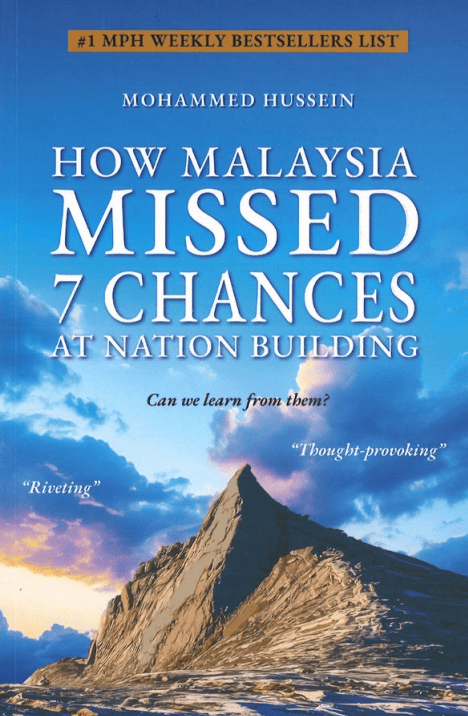
This had stirred my thinking. Do not get me wrong! I was not disappointed with the book and in fact from then onwards I kept reading the book until its end. Nevertheless, my view started to change, there was a whisper in my ear that the author had valid points for the remaining 6 missed chances. Whether a multi racial UMNO (1951) or the ‘best for Malaysia’ rather than a ‘compromised’ Constitution (1957) could have given us a better outcome? Furthermore, a cut short MAGERAN (1969–1971) with an intention to bring the country back to democracy should be praised rather the possibility of the country falling into hands of a dictator with a prolonged MAGERAN could have brought us to a bleak future like Myanmar. Nobody knows the answers unless there was a movie like ‘Back to the Future Part II’.
I opened my mind up and gave a chance by reading further the author’s points of view. I cannot help appreciating the angle that he offered on what could have taken place and what the country could have been now. His views were provoking, there were certain matters which I had not put enough thought to. Whatever it is, the author’s views were indeed original. Not only had he offered practical solutions on how the country should march forward, he was also able to defend his views which might be regarded as sensitive. NEP with good intention ended up with NEP favouring the Elites (1971–1990), Vision 2020 on auto pilot remained just a vision and finally the reformation mandate of 2004 and 2018 ended up with too much politicking.
What then went wrong? Perhaps one of the factors or a combination had brought us here. Somewhere along the timeline after independence, our nation likely took some wrong turns. Notwithstanding fair to say, the author and me agree that we are not in the right direction now.
Just like watching a good movie, I will not steal the joy and ‘thunder’ from other people reading this book. The author who is a senior banker advocated the way forward. His recommendations on key reforms are solid, practical and achievable. Whether you agree or not is a separate matter. I would highly recommend people especially current and future leaders explore this book. It will help us to improve and shape a better future for our children and for Malaysia to become successful with diverse people or people with many races and admired worldwide. Let me end with the same earlier message “It is still not too late for all of us”.