
Author: Mehran Gul
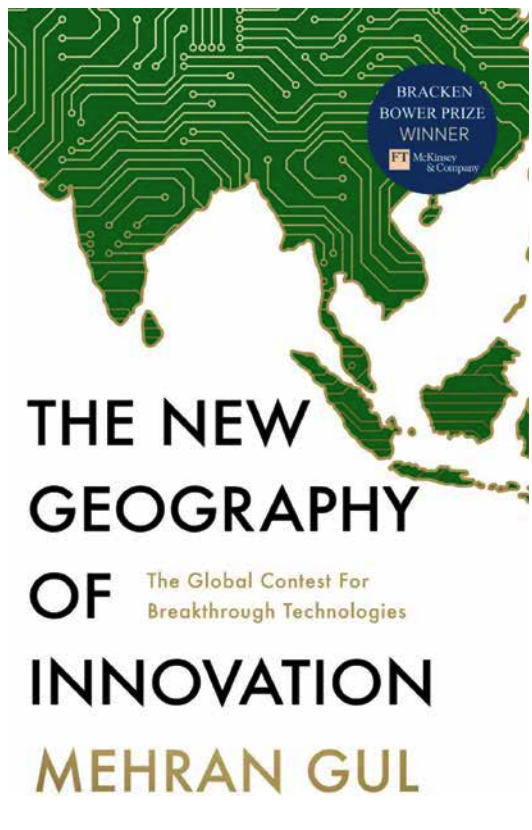
There are books you read to escape, and there are books you read to stay ahead. Mehran Gul’s The New Geography of Innovation belongs in the latter category. When most conversations about technology still revolve around Silicon Valley, Gul invites us to look elsewhere. He shows that innovation today is forming in many parts of the world, often outside the public eye.
This is not a book of theory. It reads instead like a travelogue of innovation, written by someone who has sat inside strategy rooms where governments, investors and technologists debate the future. A Fulbright scholar and Yale alumnus, Gul previously served at the World Economic Forum in the Digital Transformation division. The proposal for this book caught international attention and received the Financial Times/McKinsey Bracken Bower Prize. It is a recognition awarded to rising business thinkers shaping future conversations
A WORLD OF NEW VALLEYS
Gul introduces several key players shaping global innovation today. His findings read like a new world map.
• Taiwan Semiconductor Manufacturing Company (TSMC) is the world’s leading chip manufacturer, producing components used by companies like Apple, Nvidia and major carmakers.
• ASML in the Netherlands is a specialised Dutch technology company that quietly powers the world’s chip production through its unmatched machines.
• Samsung and LG in South Korea are not just consumer brands but national champions in battery development and energy technology.
• Spotify and the Nordic gaming industry in Sweden demonstrate how creativity and platform design can become powerful exports.
• Arm in the United Kingdom is a British technology company whose chip blueprints are used inside more than 90% of smartphones worldwide, even though its name rarely appears on any device.
Each chapter blends industry insight with human stories. Founders, engineers and policymakers appear throughout the narrative. Through them, Gul shows how culture, state capacity and long-term investment create conditions where innovation does not happen by accident. It is built with intent.
A REFLECTION FOR READERS WHO LEAD
Members of The Royal Selangor Golf Club will find resonance here. Gul’s argument is subtle but clear. Innovation is not magic. It is the outcome of deliberate systems. It grows from strong institutions, a culture of excellence, talent pathways and a shared national mission.
Malaysia and Singapore make brief appearances, particularly through the lens of talent mobility and the region’s battle to retain its brightest minds. While the book does not dwell on Southeast Asia, it presents a useful mirror for leaders, investors and decision-makers who recognise that strategy today is global by default.
READING EXPERIENCE
The pace is brisk. At times, it feels almost cinematic as it moves quickly between countries and companies. Some readers may wish for more depth in the Malaysian or regional context. Yet the book’s strength lies in its wider perspective. It is, in Gul’s words, “a global sweep delivered with a strategist’s precision.”
This is not just a book for those in technology. It is for anyone who believes that to remain relevant, as individuals, organisations or even nations, one must understand where the world is quietly reconfiguring itself.
“Legacy,” as The Royal Selangor Golf Club often reminds us, “is not just inherited — it is built.” Reading this book is less about acquiring facts, and more about adopting a mindset: one that recognises opportunity not where it is loudest, but where it is forming.
ABOUT THE AUTHOR
Mehran Gul is a Fulbright scholar and Yale University graduate. He previously served in the Digital Transformation division of the World Economic Forum. His manuscript for The New Geography of Innovation won the Financial Times/McKinsey Bracken Bower Prize, awarded annually in London and New York to the best business book proposal in the world by a writer under 35.
PRIZE HIGHLIGHT
FT/McKinsey Bracken Bower Prize
Established in 2014 and worth £15,000, this prize identifies emerging business thinkers under the age of 35 whose ideas can shape global economic conversations. Past winners have gone on to influence policy, investment and strategic leadership around the world.