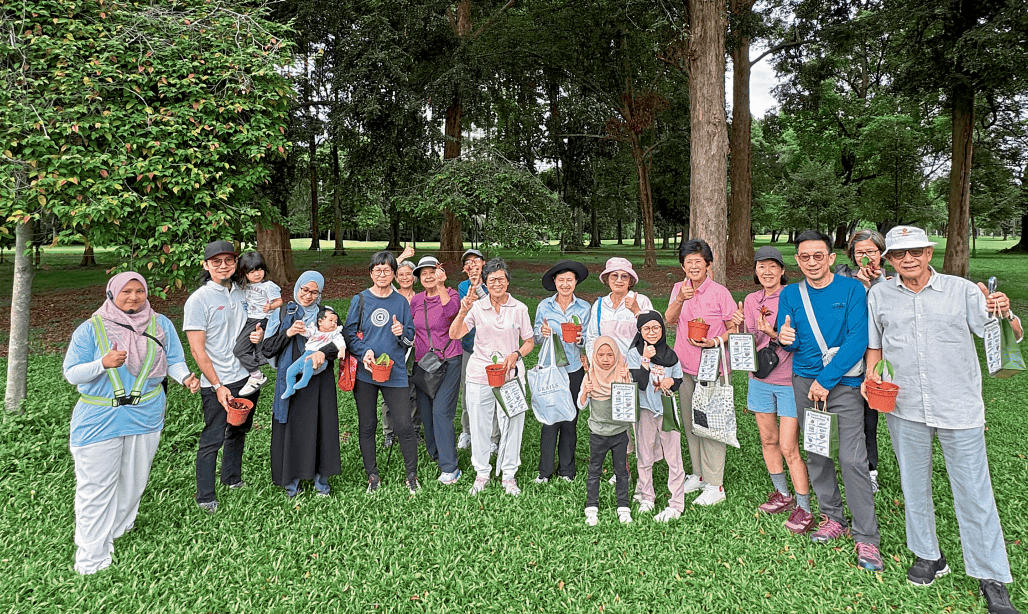
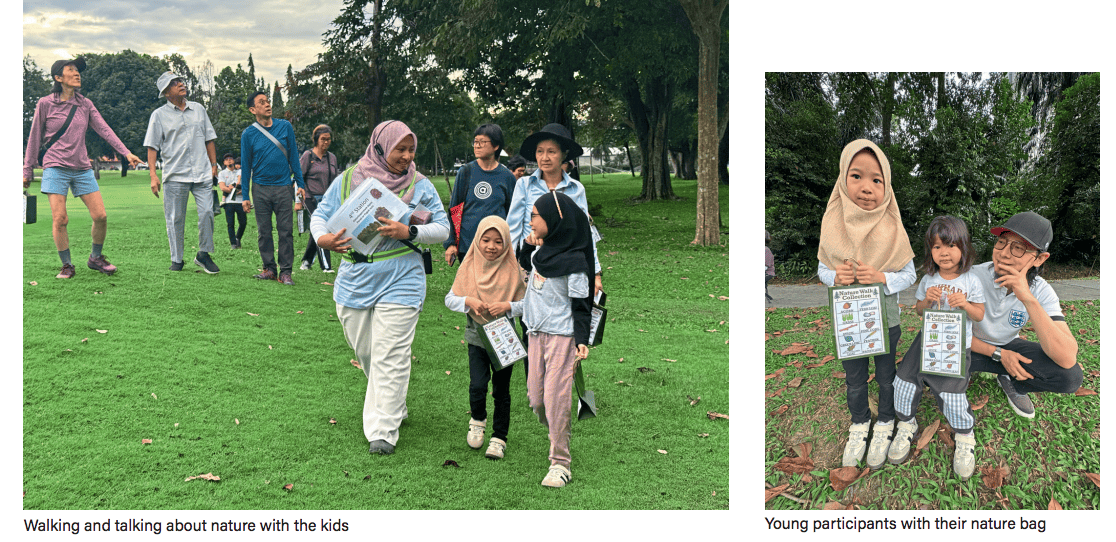
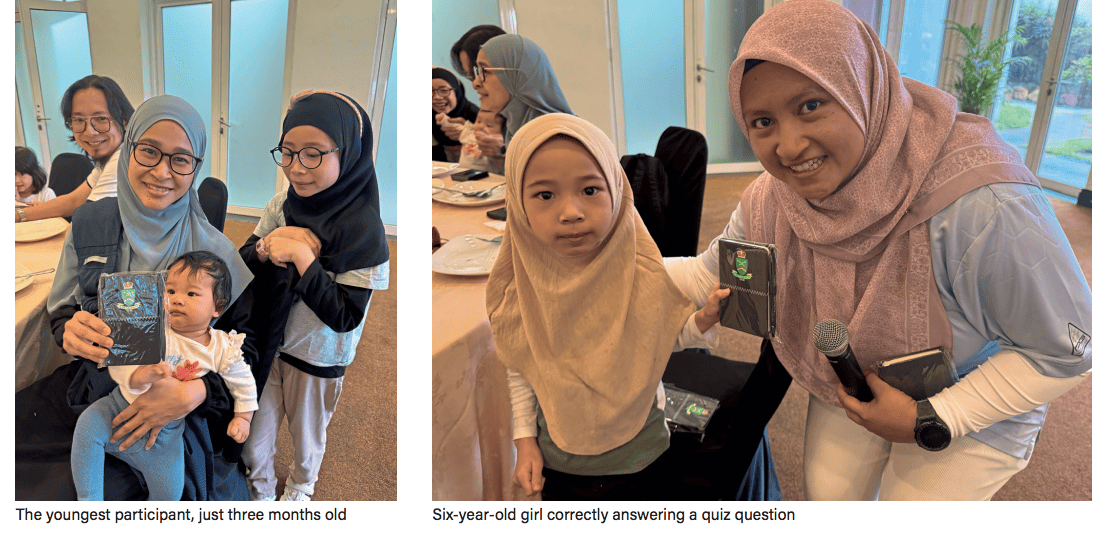
The participants were introduced to each tree in the hall and briefed on the basic characteristics of the trees. Information was shared about their flowers, leaves, and fruits. A bag collection was distributed as nature walk bag collection for all the participants. A total of 17 participants were registered, with the youngest participant being a three-month-old baby joining the nature walk.
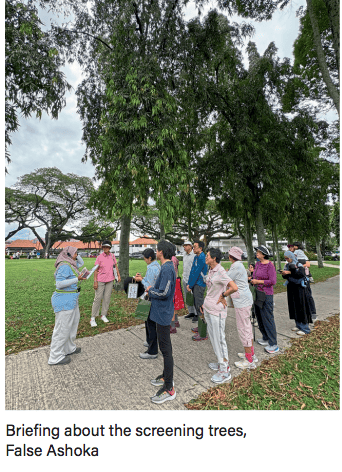
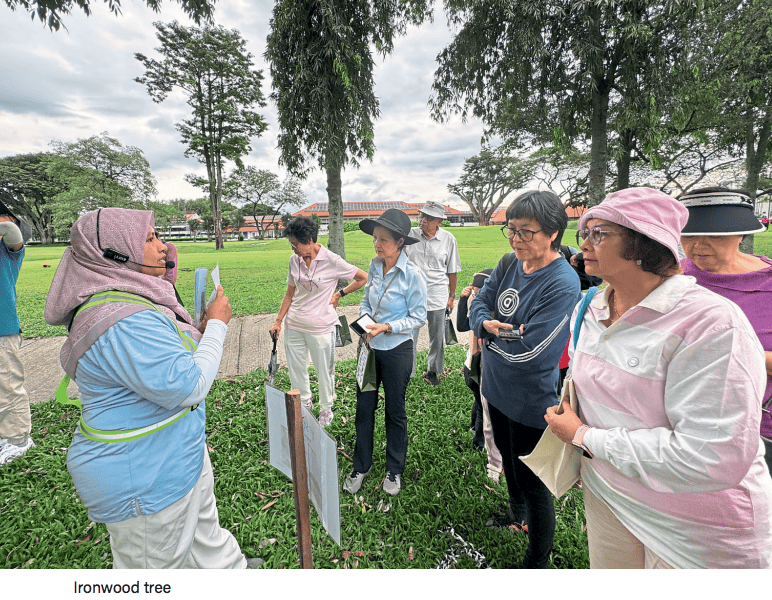
The group proceeded to the first station, walking along the left side of Hole 10 toward the ironwood tree. Before reaching the first station, participants were introduced to the False Ashoka tree. Its unique properties were explained, including its medicinal benefits, particularly its positive effects on genetics and female fertility, as highlighted in previous nature walks.
Unfortunately, while walking toward the selected ironwood tree, a golf ball from a tee shot at Hole 10 of the old course struck the leg of one of the participants, Mr. Wong Poon Ming, causing a bruise. This incident marked an unfortunate start to the day. However, they apologized for not being careful with the shot.
PENAGA LILIN
Starting from the first station, participants were briefed on the tree’s flowers, which bloom simultaneously and resemble a fried egg in a pan. The flowers emit a fragrant scent and are visually appealing. However, during this visit, the tree was not in bloom. Participants were shown seeds that had been collected by the horticulturist a month earlier. It was explained that the seeds are easy to propagate and will sprout once they fall to the ground. Although the tree grows slowly, it is well suited for ornamental planting due to its conical shape. The tree is commonly known as Penaga Lilin, a name that reflects its candle-like appearance, resembling a flame burning at the tip. The bark was also noted to peel off in irregular patterns.
TULANG DAING
After crossing the Hole 10 fairway to reach the next station, the selected tree for the second station was the Tulang Daing tree, also known as the Purple Millettia tree. Mr. Wong Poon Wing asked the horticulturist how the trees were chosen for the nature walk. It was explained that trees with unique characteristics and limited numbers on the golf course were selected, with the objective of learning about native Malaysian trees before they become extinct. For instance, not many people are aware that the fresh leaves of this tree can be eaten as ulam. Normally, ulam leaves are harvested from smaller trees, but this species is unusual due to its large size. The fresh leaves are also more expensive compared to other ulam varieties. These leaves are a personal favorite of the speaker, who only discovered their source after working at the location for five years. However, the flowers could not be seen, and participants were unable to taste the saw leaves as they were located too high in the tree.
KELAMPAYAN
The group then proceeded toward Hole 11 of the Old Course, where the horticulturist highlighted a very tall and well-known tree that has recently gained commercial importance. This tree has many uses, including medicinal applications from its bark, which is used as a tonic to treat fever and diarrhea. Its leaves are also valued for their medicinal properties. Several years ago in India, the fragrant flowers or fruits were used to produce a basic perfume blended with sandalwood, known as attar oil. Fruits collected from the ground a day earlier were shown to participants, who were encouraged to touch the fluffy, fully matured fruits. These fruits emit a scent similar to Arabic perfumes. Monkeys are known to favor this tree because the fruits are very sweet.
The Kelampayan tree is well known for its role in reforestation due to its rapid growth and tall structure. Although only one such tree is found at the site, it is widely cultivated in Pahang for reforestation purposes. Its trunk is also suitable for producing plywood and paper pulp due to the smooth texture of the wood.
PERAH
From the tee, participants walked along the buggy track toward the next three stations at Hole 11. The fourth station featured the Perah tree, which rarely bears fruit in the central Kuala Lumpur area. RSGC discovered the tree during its fruiting season. Belonging to the same family as durian, the tree fruits seasonally and has a fruit structure similar to durian. Fruits collected by the horticulturist during the June season were shown to participants. It was previously mentioned during earlier nature walks that although the tree appears dry during the dry season, it is actually shedding its leaves. The fruits can be cooked or roasted but should not be consumed in large quantities, as the latex may cause dizziness.
SAGA
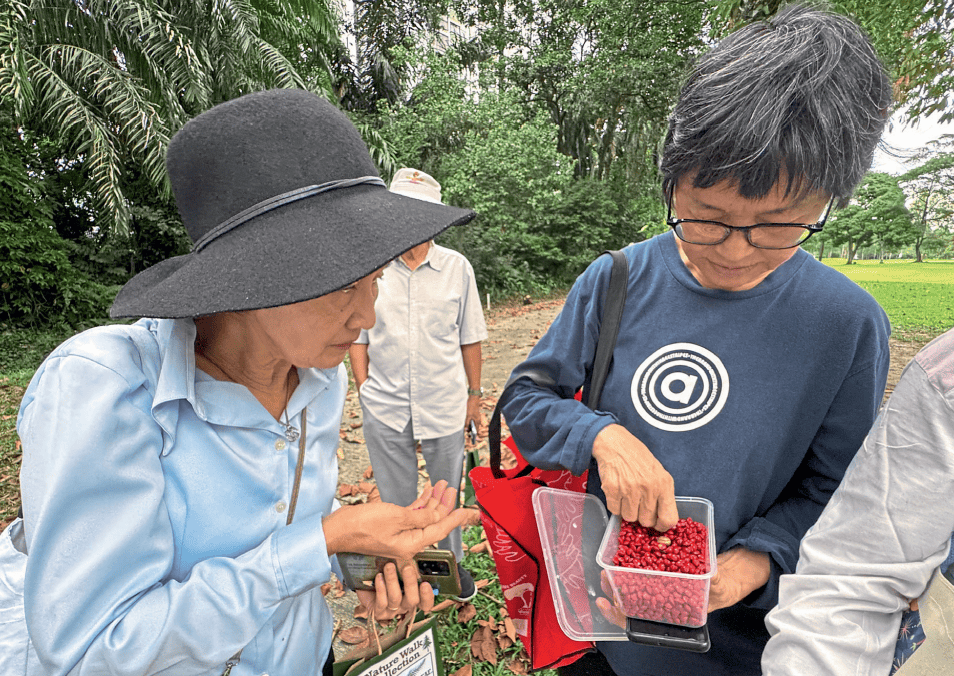
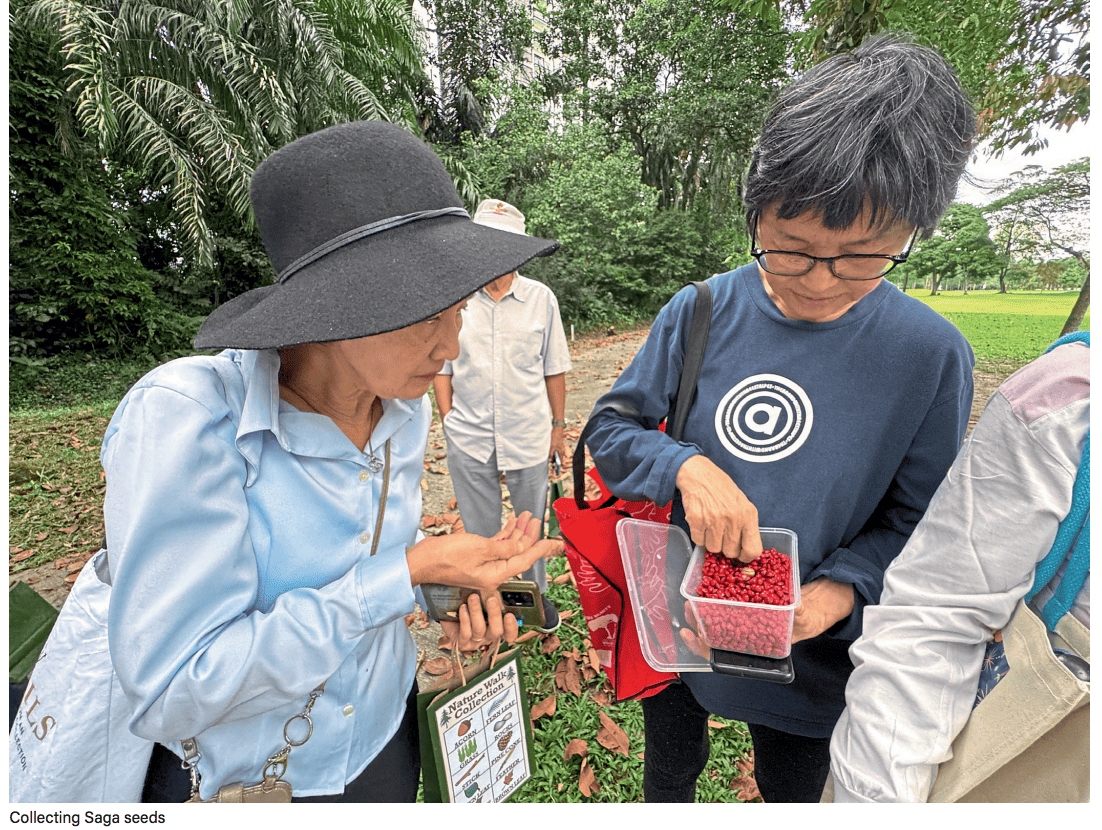
The next tree located behind the Perah tree was the Saga tree. Puan Zuraidah mentioned that she was unaware of its presence, having thought it was only planted at the first Old Course. It was explained that the tree was likely planted among other trees in the past, or that its seeds may have been dispersed by birds. Many participants recalled the Saga seeds from childhood, when they were used to make necklaces or as ammunition for slingshots. Before standardized weight units existed, Saga seeds were used to measure gold, with four seeds equaling one gram. This fact was shared by a participant during a 2022 nature walk. Saga seeds are known for their striking wine-red color, and each seed pod consistently contains 25 seeds. The tree also inspired the name of Malaysia’s first national car. Many participants collected Saga seeds and fruits as souvenirs during the walk.
A six-year-old child collected residue from Mahogany fruits and asked about them. It was explained that these were sky fruits, commonly used to help control blood pressure and cholesterol. This tree was skipped during the walk as it had been frequently discussed in previous nature walks.
SEMAMBU
The group then proceeded to the Neem tree, which holds strong religious and cultural significance for the Indian community. The Neem tree is unique for its extensive medicinal properties and is often referred to as the “village pharmacy,” as nearly every part of the tree can be used for treatment. Participants were also shown a cluster of trees resembling broccoli, identified as Merawan Siput Jantan. One advantage of this tree is that it does not require pruning, as it naturally self-prunes.
KAPUR
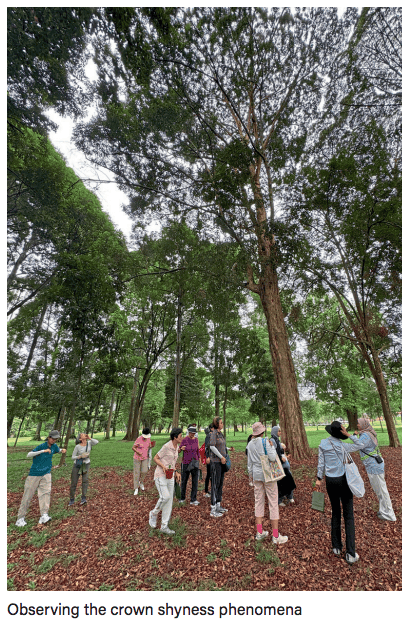
Due to the presence of many mosquitoes, the group moved on to observe the phenomenon of crown shyness in the Kapur tree. During previous nature walks, participants were introduced to the tree’s flowering characteristics. From August to November, the flowers bloom rapidly, a phenomenon that occurred again after three years. The horticulturist took the opportunity to transplant the seeds into the nursery and demonstrated how they regenerate into leaves. Ten seedlings were brought and offered to participants who had suitable space to plant them at home. Historically, Kapur trees were valued for timber and used in railway tracks. They also attracted Arab traders to Borneo for the extraction of aromatic dammar oil. Whether fresh or fallen, the leaves release a fragrant aroma when crushed.
At the centre area, participants learned more about the tree’s ability to create the crown shyness phenomenon. The horticulturist explained that “crown” refers to the upper canopy of the tree, while “shyness” describes how the leaves do not overlap with neighbouring trees. Seeds collected earlier from the second hole of the New Course were distributed to participants for home planting, with hopes of growing new Kapur trees for future generations.
The nature walk concluded at the hall with a short video presentation and quizzes. Positive feedback was received from participants, who found the experience both enjoyable and educational, gaining insight into the unique characteristics of trees that are limited within the golf course. It was a pleasure to share this knowledge, and participants were encouraged to stay tuned for the next nature walk scheduled for April 2026.
Come and join us again for more discoveries!