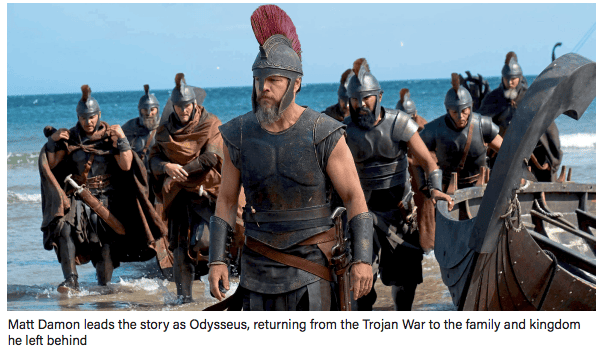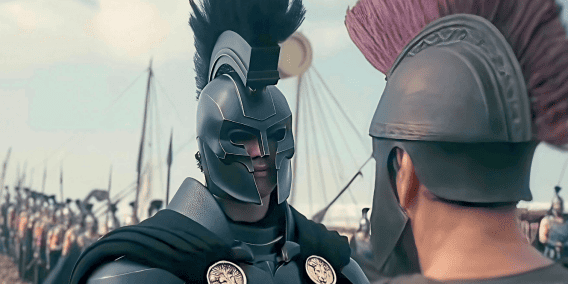
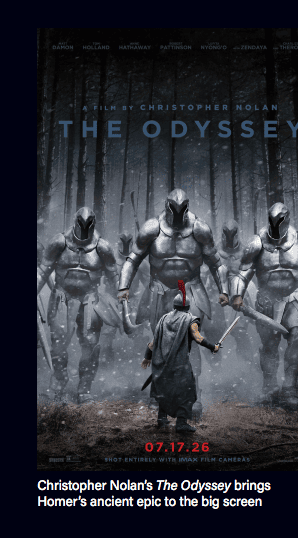
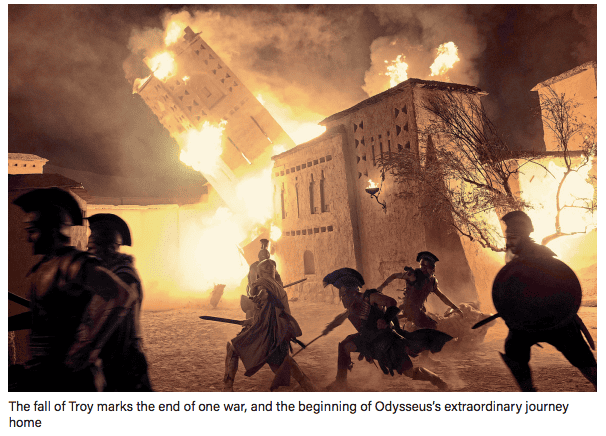
For ten years, Odysseus fought a war. It would take him another ten to get home. That simple premise lies at the heart of The Odyssey, the ancient Greek epic traditionally attributed to Homer. Nearly 3,000 years later, Christopher Nolan brings the story to the screen as a spectacular adventure of gods, monsters, war and survival.
Yet what stayed with me was something much simpler. This is ultimately a story about home. A man desperately trying to return to it, a woman who refuses to give up waiting for him, and the terrible price paid along the way
THE LONG JOURNEY HOME
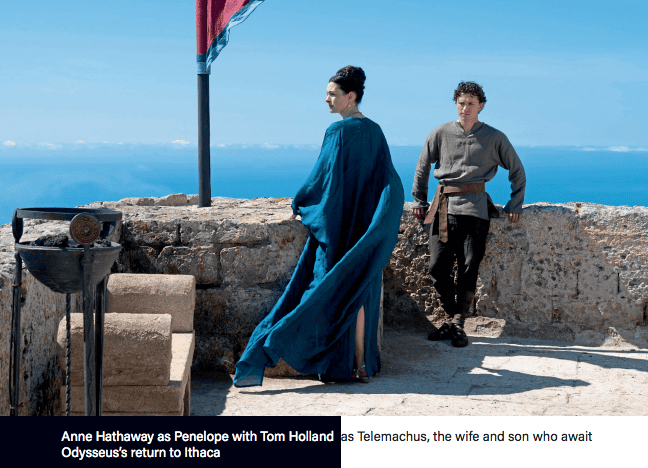
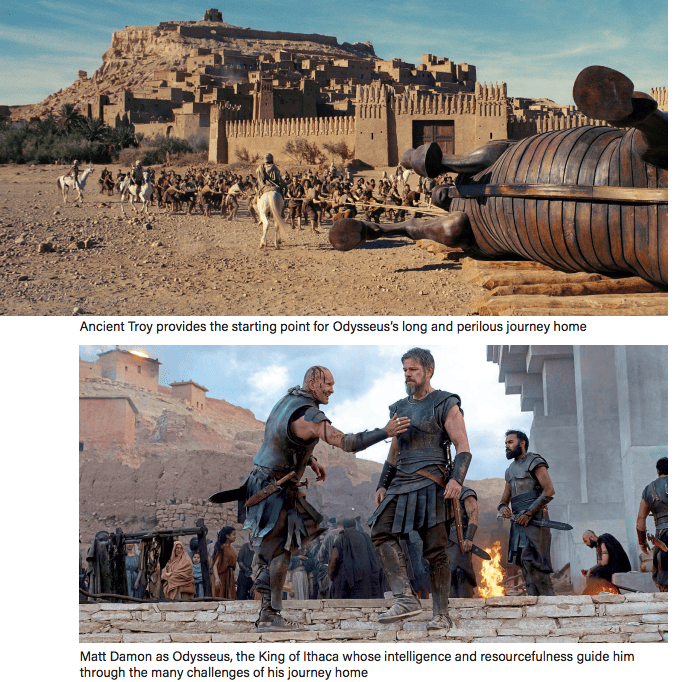
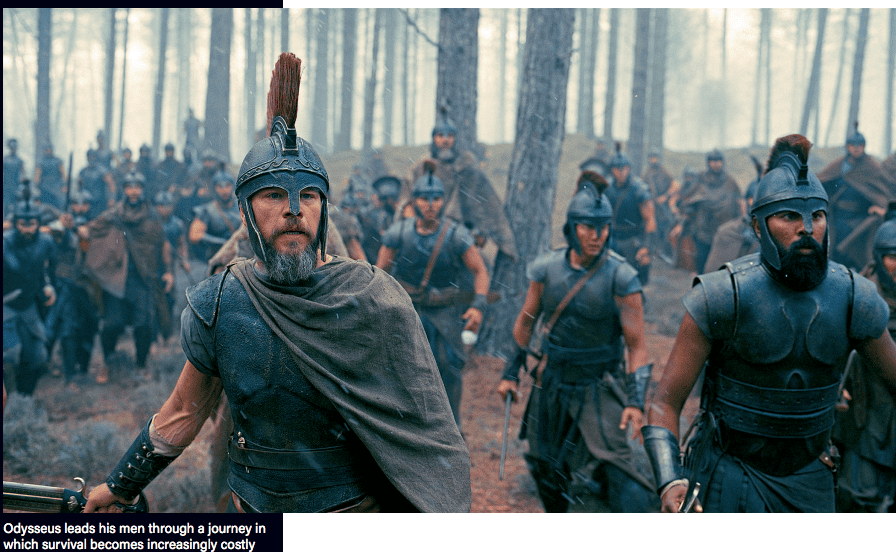
Matt Damon plays Odysseus, King of Ithaca, returning from the Trojan War to his wife Penelope, played by Anne Hathaway, and their son Telemachus, played by Tom Holland.
Odysseus is not simply a warrior. His greatest strength is his intelligence, and throughout the journey we watch him think, deceive and improvise his way through seemingly impossible situations. And there are plenty of them.
One of the most memorable is his encounter with Polyphemus, the Cyclops, when Odysseus and his men become trapped with a creature far stronger than themselves. Then comes Circe, played by Samantha Morton, the sorceress who transforms his men into pigs. The transformation is grotesque and disturbing, one of those scenes that made me recoil while still being unable to look away.
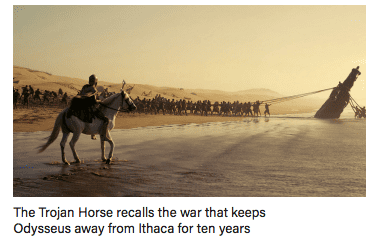
By this point, however, I had become so invested in Odysseus and his men that these encounters no longer felt like separate mythological adventures. Every new danger carried the possibility that someone else would not make it home. And increasingly, they did not.
Odysseus keeps surviving. His men do not. The closer he gets to Ithaca, the more his journey becomes burdened by the memory of those who followed him but would never see home again.
THE MYSTERIOUS ATHENA
Throughout the film I was also intrigued and initially rather confused by Zendaya’s character. She appears almost like a spirit, speaking to Odysseus and guiding him while seeming somehow separate from the physical world around him. Eventually, we understand that she is Athena, the Greek goddess of wisdom and warfare and Odysseus’s divine protector.
Suddenly, her unusual presence makes sense. She is not another traveller on the voyage, but part of the divine world watching and sometimes intervening in the lives of mortals. I actually enjoyed not understanding immediately. The explanation became part of discovering the mythology as the story unfolded.
THE WOMAN WHO WAITED
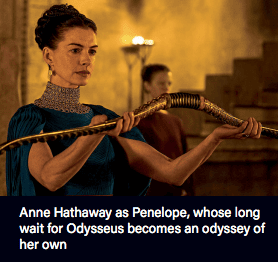
But it was Anne Hathaway’s Penelope who affected me most. While Odysseus spends twenty years fighting and travelling, Penelope experiences those same twenty years from home.
She watches their infant son, Telemachus, grow into a man without his father. She does not know whether her husband is alive or dead. Meanwhile, suitors gather around her, hoping to replace the King who everyone assumes will never return.
Odysseus can fight, escape and keep moving. Penelope can only wait. Yet waiting becomes its own form of courage. She protects their home, resists those seeking to take her husband’s place and somehow continues to believe that he might return. Their battles could not be more different. Odysseus is fighting his way back to his family and kingdom, while Penelope is fighting to preserve both until he returns.
THE MAN I COULD NOT WAIT TO SEE FALL
Then there is Robert Pattinson’s Antinous. I genuinely could not stand him, which probably says everything about how effectively Pattinson plays him. Arrogant, manipulative and cruel, Antinous covets everything belonging to the absent King: his wife, his authority and his kingdom.
Yet underneath the arrogance is cowardice. He behaves like a powerful man only because he believes Odysseus will never return. So yes, when his reckoning finally comes, I found it enormously satisfying. And it comes through one of my favourite sequences in the film.
THE BOW THAT REVEALS THE KING
Penelope presents her suitors with a challenge involving Odysseus’s bow. One after another, the men attempt it. One after another, they fail. Then an insignificant-looking beggar asks for his turn.
What they do not know is that the beggar is Odysseus, finally returned to Ithaca in disguise. He takes the bow. He strings it. And suddenly everyone understands. Before Odysseus even needs to proclaim who he is, the bow has revealed the King.
The man they believed would never return is standing in his own home. And with his identity revealed comes the reckoning, not only for the suitors, but for those who betrayed him during his absence.
I particularly liked this element of the story. By returning disguised as someone without status or power, Odysseus discovers who people really are: who remained loyal when there was nothing to gain from loyalty, who betrayed him when they thought he was gone forever, and how people treated a man they believed was beneath them. A crown could never have shown him that. His disguise did.
NOLAN’S EPIC
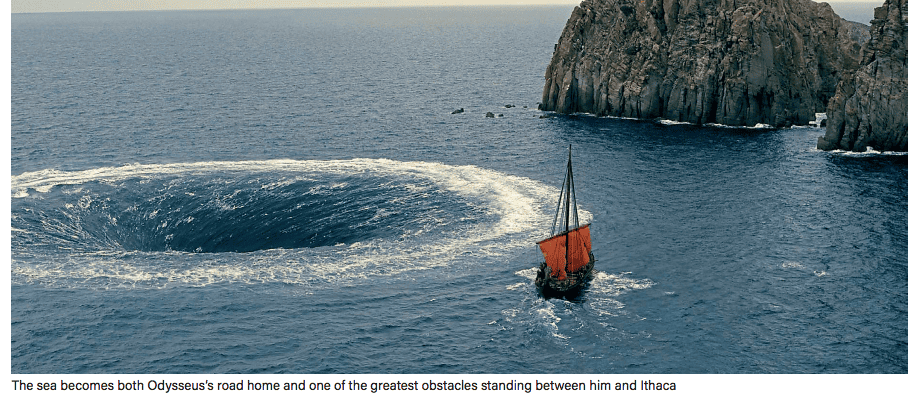
Christopher Nolan tells this ancient story on an enormous scale. The production was filmed entirely using IMAX film cameras, with Nolan and cinematographer Hoyte van Hoytema using real locations and landscapes to give Odysseus’s world a remarkable physical presence. The sea feels vast, the ships vulnerable and the landscapes almost overwhelming.
Yet for all its visual spectacle, the film never loses sight of the human story at its centre. By then, I was no longer simply watching Odysseus’s journey. I had become invested in it, hoping that after everything he had endured, he would finally make it home.
ONE FINAL JOURNEY
When the King finally returns and the traitors have been exposed, we might expect Odysseus simply to reclaim his throne. Instead, Nolan gives him a different ending.
Telemachus inherits Ithaca, while Odysseus and Penelope leave together, sailing west to honour the men who died and never returned. A significant departure from Homer’s original ending. I found that choice deeply moving.
The King who began his journey as a warrior ends it understanding the human cost of everything that happened in his name. And Penelope goes with him. She waited twenty years for her husband to return. Now, instead of waiting while he makes yet another journey, she travels beside him.
For all its monsters, battles and spectacular landscapes, that is what stayed with me after The Odyssey. Penelope’s waiting. A son growing up without his father. The men who never came home. The satisfying fall of those who betrayed their King. And that wonderful moment when Odysseus takes a bow nobody else can master and, without needing a crown, tells everyone exactly who has returned.
For ten years, Odysseus fought a war. For another ten, he fought to get home. And perhaps, after twenty years apart, home was finally being able to journey beside Penelope again.